
Imagine this: You enter a trade with a well-thought-out plan. Minutes later, you see the market swing and — boom — you exit early out of fear. Or worse, double down because you “felt” like it might reverse. Sound familiar? If you’re between 20 and 40, chances are you’ve been there. You know the charts and indicators, but your emotions still hijack your decisions.
That’s the quiet trap.
The most significant losses in trading don’t always stem from poor strategy—they arise from unmanaged emotions and unnoticed mental biases. Fear of missing out (FOMO), revenge trading, and overconfidence after a win streak aren’t just character flaws. They’re predictable, trackable behaviors rooted in psychology.
And here’s the truth no one tells you:
You won’t outsmart your emotions, but you can out-document them.
That’s where a trading journal comes in.
Not a boring log of entry and exit points. An actual trading journal is your emotional mirror. It reveals what the market never shows — you. It helps you document not just your trades, but your reasons, fears, and impulses — the fundamental drivers behind every click of the buy/sell button.
By consistently recording your thoughts, emotions, and rationales, you start to notice patterns in your behavior, not on the chart. This is where emotional discipline begins: with self-awareness. And no tool does that better than journaling.
Because, let’s face it — the market doesn’t care about your feelings. But your journal?
It remembers everything.
So, if you’re tired of making the same mistakes and whispering, “I knew I shouldn’t have done that,” it’s time to write it all down. That’s not weakness. That’s mastery in progress.
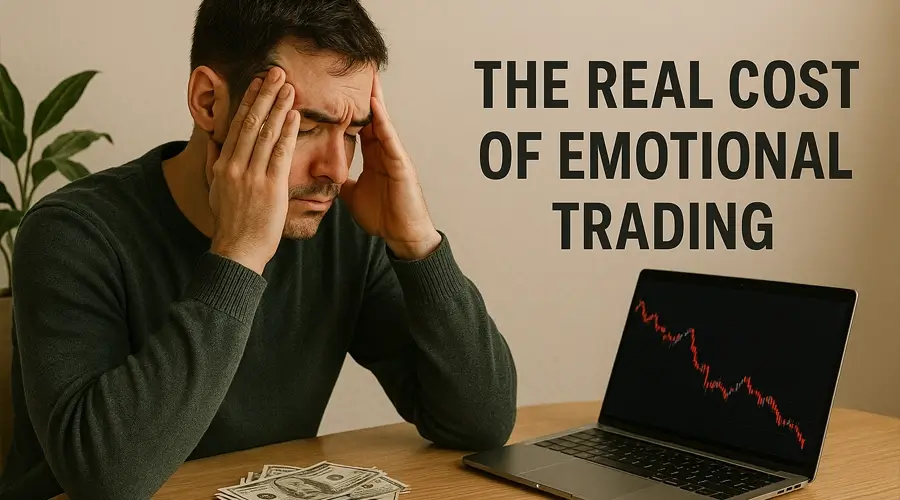
The Real Cost of Emotional Trading
When Your Mind Becomes More Dangerous Than the Market
Let’s cut the fluff: the market doesn’t ruin traders — traders ruin themselves. Not because they lack technical skills, but because they lose the mental game.
Losing $200 on a bad setup is the real cost. But the actual loss happens when that loss makes you chase the next trade out of revenge. Or when a lucky win makes you feel invincible, causing you to throw risk management out the window.

These moments don’t show up on your trading platform. They show up in your behavior. And they’re all fueled by something more profound: trading biases.
Let’s break down a few that silently drain your edge:
Confirmation Bias
You’re already long on EUR/USD. You scroll through Twitter and suddenly, every tweet that supports your bias feels like gospel. You ignore those who say “trend reversal” because it feels uncomfortable.
Result: You hold too long. You ignore warning signs. You lose.
Recency Bias
You’ve had three losing trades. The fourth setup looks clean, but you hesitate. Not because the trade is bad, but because your memory of loss is louder than your logic.
Result: You miss solid setups and reinforce doubt.
Revenge Trading
A single trade wiped out your gains. You jump back in, not to follow your system, but to prove something. To win it back. To feel in control again.
Result: Bigger losses. Emotional spiral. Burnout.
These aren’t mistakes. They’re loops. And they repeat themselves — unless you catch them in the act.
And here’s the kicker:
Most traders don’t even realize they’re doing it — until it’s too late. Because biases don’t appear on candlestick charts, they live in your reactions. In your stories. In your justifications.
So, how do you stop repeating what you can’t even see?
You document.
You pull those biases out of the shadows and onto the page. You name them. You study them. That’s how you break the loop.
Your trading journal isn’t just a record of your trades. It’s a record of your mind in motion. And something changes once you start tracking your thoughts the same way you track your entries. You stop being reactive. You start being intentional.
Track your trades smarter with Journalio.
Let AI reveal your patterns and boost your performance.
What Makes a Good Trading Journal?
Let’s get one thing straight — if your trading journal is just a spreadsheet of entry, exit, and profit/loss… you’re doing it wrong.
That’s a ledger, not a journal.
A real journal doesn’t just track your trades — it tracks your mind.
So, what makes a journal powerful enough to change the way you trade?
1. The Core Components of a High-Impact Trading Journal
A truly effective journal should include:
- Entry/Exit Details:
The basics — instrument, time, price, direction
BUT — also include the “why” behind the trade - Pre-Trade Thought Process:
What were you feeling before entering? Was there doubt? Excitement? Were you following a signal or reacting emotionally? - Risk/Reward Expectation:
Note your target, stop loss, and why you chose them.
This clarifies whether your decisions are based on strategy or wishful thinking. - Post-Trade Reflection:
Whether it’s a win or a loss, what can you learn? Did you follow your plan? Was there confirmation bias? Did you cut a winner short out of fear? - Emotional Snapshot:
Rate your emotional state 1on a scale of –10 before and after the trade.
Simple. Powerful. Tells you more about you than any chart. - Recurring Behavioral Patterns:
Every week, review your journal and write down patterns.
Are you always anxious on Mondays? Do you trade better in the afternoon?
These are your mental tells.

2. Why Documentation Beats Memory Every Time
You might think you’ll remember why you made that trade. Spoiler: you won’t.
Your brain will rewrite the memory to justify the outcome. It’s what brains do.
But when written down, raw and honest, it’s there to challenge you, hold you accountable, and prevent you from romanticizing your mistakes or villainizing your losses.
3. Entities That Power Up Your Journal
To truly elevate your journaling game, consider tracking these entities:
- Market Conditions (trending, ranging, volatile)
- Trade Setup Type (breakout, pullback, news-based)
- Technical Indicators Used (EMA, RSI, MACD)
- Execution Quality (early/late/spot-on)
- Mindset Notes (calm, pressured, overconfident)
The more contextual data you collect, your journal becomes a personalized playbook rather than just a logbook.
Analyze like a pro with Master the Market.
Learn, trade, and stay one step ahead.
Uncovering Your Biases: How Journaling Exposes the Hidden Patterns
You’re Not a Bad Trader — You’re Just on Autopilot
Here’s the uncomfortable truth:
You’re not just trading the market — you’re selling yourself.
And the worst part? Most of the time, you’re doing it without realizing it.
Think about it.
Have you ever:
- Entered a trade just because your last one was a loser and you “had to make it back”?
- Doubled your lot size after a win because you felt “on fire”?
- Hesitated to close a losing trade because you didn’t want to admit you were wrong?
These aren’t random mistakes. These are trading biases — deeply ingrained mental shortcuts your brain takes to feel safe. And until you bring them to light, they will control you.
How a Trading Journal Becomes Your Bias Detector
The key isn’t to eliminate bias (that’s impossible).
The key is to see it in real time — and that’s what journaling does.
Let’s look at how:
Case Study: The Confirmation Bias Trap
You journal five trades. In four of them, you wrote:
“Saw bullish signal, checked Twitter — others agreed.”
“Ignored bearish divergence — felt market was still strong.”
Review your week and realize: You’re not analyzing — you’re filtering.
Your brain is cherry-picking information to support your bias.
Your journal just caught you red-handed. Now you can fix it.
Case Study: The Overconfidence Spiral
Your post-trade notes read:
“Felt invincible after Monday’s win — got sloppy Tuesday.”
“Skipped checklist, rushed in — felt like I knew it’d drop.”
You didn’t lose because the market betrayed you. You lost because you trusted your ego more than your system.
Again, your journal isn’t judging you — it’s revealing patterns.
And patterns? You can break them.
Weekly Review = Pattern Extraction
A few minutes of honest review each week can show you more than hours of screen time.
Here’s what to look for:
- Are you always emotional on certain days?
- Do you overtrade after wins or freeze after losses?
- Do you trust your analysis more at the beginning or end of the week?
These insights don’t come from memory — from data you recorded under pressure, not hindsight. And that’s gold.
From Awareness to Action: Rewiring the Mindset
Knowing Isn’t Enough — Now You Act Differently
Okay, so you’ve identified your biases. You’ve seen the emotional loops.
You’ve highlighted the “Oops, I did it again” patterns in your trading journal.
But here’s the critical step most traders skip:
Turning awareness into action.
Because knowing you panic in high volatility means nothing — unless you build a plan for the next time it happens.
The Feedback Loop That Builds Discipline
Let’s simplify the formula:
- Document the Emotion
“I felt anxious before entering because I didn’t trust my analysis.”
- Analyze the Decision
“Despite the anxiety, I stuck to my rules and exited at TP.” - Extract the Learning
“I perform better when pre-defining exit plans, especially under stress.” - Design the Fix
Add a checklist item: “Is your exit plan clear before entering?”
This is how you rewire your mindset — not through motivational quotes but structured reflection and minor behavioral tweaks.
The Power of Pre-Mortem Journaling
Most people only journal after a trade. But elite performers do something different — they simulate the future.
Before entering a trade, ask yourself:
“If this goes wrong, why would that happen? What’s the most likely emotional pitfall I might fall into?”
Write that in your journal. Now you’ve exposed the monster before it strikes.
This technique, borrowed from military and startup strategy, is called a pre-mortem and is devastatingly effective in trading.
Build Mental Rules, Not Just Trade Rules
Your strategy might tell you when to enter, but does it tell you:
- What to do when you feel FOMO?
- When to walk away from the screen?
- How to handle back-to-back losses?
Your trading journal is where these mental rules are born. And every time you follow one of them, you’re not just trading better — you’re proving to your brain that you’re in charge now.
Keep a smart advisor by your side with AI Chatbot.
Analyze, decide, and act faster—every time.
Sustaining Emotional Discipline Over Time
Because Discipline Isn’t a One-Time Win — It’s a Daily Ritual
So you’ve got your trading journal, faced your biases, and started to rewrite how your brain responds under pressure.
Great start.
But here’s the hard truth: Discipline fades — unless you actively protect it.
In the beginning, journaling feels exciting. You’re learning, evolving, and tracking patterns like a detective.
But fast-forward a few weeks, and it can feel like a chore.
This is where most traders fall off.
Not because the method doesn’t work, but because they expect permanent results from temporary effort.
So, how do you stay emotionally sharp long term?
Make Journaling Effortless — Not Perfect
Perfection kills consistency. You don’t need a beautifully formatted PDF after every session.
You need honest notes, quickly recorded, in a format you’ll stick to.
Try these:
- Voice Notes Post-Trade (use apps like Notion or Evernote)
- Emoji-Based Mood Tracking
- Short Prompts Instead of Blank Pages
“What was I feeling before the trade?”
“Did I follow my process?”
“What would I do differently?”
Don’t overthink it. Do it.

Use Tools That Work With You, Not Against You
Digital journaling tools can make a huge difference. Here are some you might love:
- Edgewonk – Tailored for traders, lets you track emotional data alongside P&L
- Notion Templates – Fully customizable, from mindset logs to bias tracking
- Tradervue / Trademetria – For traders who love data and visuals
- Google Sheets + Zapier – Build your tracking system if you’re a geek like that
Whatever you use, just make sure it fits your flow. The best tool is the one you’ll keep using.
Emotional Discipline Is a Practice — Not a Personality Trait
You’re not born emotionally disciplined.
You become disciplined by noticing your triggers, preparing for them, and choosing better over and over again.
Journaling isn’t just about trading.
It’s about training your nervous system to stay calm under fire.
It’s about becoming someone who doesn’t flinch when pressure shows up.
Over time, you stop reacting. You start responding.
And that shift? It changes everything.
Bonus Habit: Journaling Even When You Don’t Trade
Some of your most important insights will come on the days you don’t trade.
What were you thinking about the market?
Did you want to force a trade?
Did you feel FOMO watching others?
Journaling those non-trade days is like going to the gym when you don’t feel like it — that’s where absolute strength is built.
Conclusion
In the end, mastering emotional discipline isn’t about suppressing your feelings — it’s about understanding, documenting, and using them to grow. Your trading journal isn’t just a notebook. It’s a mirror. One that reflects the trader behind the trades. And when you look into it honestly, every bias, every impulse, every breakthrough, you gain more control over your trades. You gain control over yourself. Because the market will always test you, the real question is: Will you walk in blind or aware? Journaling makes the difference.


