
Consistent trading success is often viewed as a mysterious art, reserved for only a lucky few. However, the truth is less glamorous—and far more empowering. Behind every successful trader lies not only a keen instinct or a powerful strategy but also a habit of relentless self-review and improvement—a tool that grants them control and boosts their confidence: a trading journal.
At the heart of this process is one crucial tool: the trading journal. Much more than just a record of wins and losses, a professional trading journal acts as a real-time mirror, uncovering patterns, highlighting emotional biases, and providing insights that no chart can offer alone. It’s not simply a record; it’s a roadmap for strategic evolution. In this article, we’ll explore how expert traders utilize their journals to refine, optimize, and elevate their strategies to new heights.
Why Do Professional Traders Rely on Journals?
Instincts alone aren’t sufficient for maintaining consistent profitability. Professional traders rely heavily on their trading journals as they function like a personal feedback loop—a mirror that reflects the invisible forces influencing every decision. One significant reason traders depend on a trading journal is to identify behavioral patterns. Success in trading often depends not just on market knowledge but also on understanding one’s habits and reactions. By reviewing entries over time, traders can identify recurring mistakes, emotional triggers, or winning strategies they might otherwise miss, fostering discovery and engagement in their trading journey. A well-kept journal also plays an essential role in enhancing emotional discipline. Trading can be emotionally intense, and split-second decisions are inevitable. Through a straightforward self-review process, traders cultivate greater emotional discipline and confidence. They learn to trust data over fear and strategy over impulse. The journal acts as a tool for tracking and managing these emotions, assisting traders in making more rational decisions. Furthermore, journaling promotes ongoing skill development. Regardless of a trader’s experience, the markets continually evolve. Professionals remain sharp, adaptable, and ahead of the curve through regular bias identification and strategy refinement. The journal functions as a means for continuous learning, enabling traders to adjust to changing market conditions and enhance their strategies.
Get instant trading insights and smart support 24/7. Trade faster, smarter, and more confidently using ARYAMERX’s AI Chatbot.
Key Elements of an Effective Trading Journal
Not all journals are created equal. Your trading journal must capture more than just the basics to level up your trading game. It should tell the full story behind every technical and emotional decision.
The foundation starts with detailed trade records. Every entry in your journal should document the trade setup: entry point, exit point, position size, and the reasoning behind the trade. Skipping these details can create significant blind spots when reviewing your performance later.
Equally important is recording your emotional and psychological state during trades. Were you confident? Hesitant? Acting out of fear or overconfidence? Emotional discipline isn’t built overnight; tracking your mindset helps you recognize the hidden drivers behind your choices.
Adding screenshots and technical notes is another game-changer. Capturing the chart at the moment you made a decision, not afterward, allows you to see the real context without hindsight bias. It also accelerates pattern recognition over time.
A strong post-trade analysis is where the real magic happens. Reviewing whether the trade won or lost and why it played out as it did turns your journal from a trading log into a performance engine. Focus on extracting performance metrics like win rates by setup, risk-reward ratios, and emotional mistakes that need correction.
An effective trading journal isn’t just about recording data; it’s about building the emotional discipline and self-awareness necessary for long-term success. It transforms your trading journey into a structured path of growth and mastery.

How Experts Use Their Trading Journals
Having a trading journal is just the beginning. What separates expert traders from the rest is how they use it day after day to sharpen their edge.
First, there’s an appreciative rhythm between daily reviews and weekly deep analysis. Each trading day, pros spend a few minutes jotting down key details: what trades they took, why they took them, and how they felt during the process. It’s quick, raw, and honest. Then, once a week, they dive deeper, identifying patterns, assessing the effectiveness of their strategies, and reflecting on their overall trading psychology. This balance keeps them grounded without getting lost in the noise.
Experts also track custom metrics tailored to their personal goals. Some monitor risk-reward ratios for specific setups, while others focus on emotional patterns like hesitation or overconfidence. These personalized numbers turn the trading journal into a powerful diagnostic tool, making it clear exactly where improvements are needed. By tracking these custom metrics, traders can identify their strengths and weaknesses and focus on improving areas that need attention.
Most importantly, professional traders use their journals to turn mistakes into future advantages. Instead of beating themselves up over bad trades, they treat each loss as a data point. Through disciplined journaling habits and regular review sessions, they systematically learn what went wrong and build safeguards for the future, transforming every setback into a step forward.
In the hands of an expert, a trading journal isn’t just a notebook; it’s a high-performance coach, quietly pushing for smarter, stronger, and more strategic trading every day.
Level up your trading skills with proven strategies and expert guidance. Dominate every market move with Master the Market by ARYAMERX.
Common Mistakes Traders Make When Journaling (And How Pros Avoid Them)
Keeping a trading journal sounds simple, but doing it effectively is where many traders stumble. Even well-intentioned journaling can waste time if certain pitfalls aren’t avoided.
One of the biggest mistakes is writing too little or too much. Some traders jot down one-line notes like “bad entry” or “felt nervous,” offering little insight when they review later. Others go overboard, turning their journal into a novel that’s impossible to analyze efficiently. Experts find the middle ground: they record just enough details to capture the essential facts and emotions without drowning in information.
Inconsistency is another major trap. A trading journal loses its power if it’s only updated sporadically. Professionals turn journaling into a daily habit—something as routine as checking charts or setting risk levels. They understand that accurate insights come from tracking behavior over time, not random snapshots.
Another common issue is ignoring emotional context. Focusing only on technical setups and forgetting how you felt during a trade can blind you to hidden biases like fear of missing out (FOMO) or revenge trading. Experts treat emotional discipline as a skill that must be logged, analyzed, and developed like any other technical ability.
Many traders fail to recognize overtrading signals. A journal isn’t just for recording individual trades — it’s also for spotting when you’re trading too frequently, risking too much, or chasing the market. Professionals review their trading journal to analyze wins and losses and identify dangerous behavioral patterns before they snowball.
Avoiding these mistakes transforms a simple notebook into a weapon for serious growth. In the trading world, awareness is power, and a well-kept trading journal keeps that power firmly in your hands.
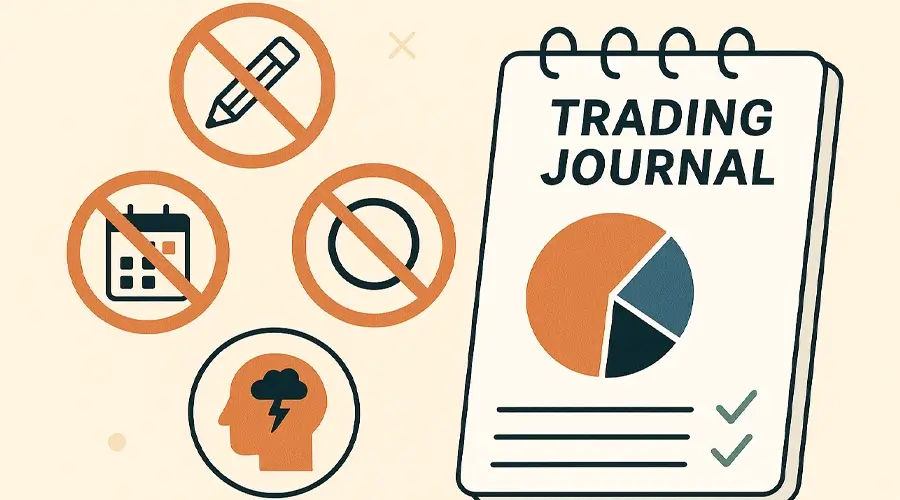
Pro Tips for Building a Powerful Trading Journal Habit
A trading journal can become your greatest asset or another dusty file you never open. The difference lies in how you approach it. Building a strong journaling habit doesn’t have to be overwhelming; it just needs to be thoughtful, intentional, and consistent.
- Keep it simple, but detailed where it matters.
You don’t need to write an essay after every trade. Focus on capturing the critical data: your entry and exit points, the rationale behind the trade, your emotional state, and a quick evaluation afterward. Overcomplicating the process makes it harder to stay consistent. - Prioritize honesty over perfection.
Your trading journal isn’t a highlight reel — it’s a private tool for growth. Be brutally honest about your mistakes, emotional swings, and moments of hesitation. The more candid you are, the more valuable insights you’ll uncover when you review your trades. - Use tools and templates that fit your style.
Whether you prefer a physical notebook, a spreadsheet, or an app, pick a journaling method that feels natural to you. Many professionals now use AI-powered trading journals that help detect patterns automatically and suggest improvements based on their behavior. The key is finding a system you’ll stick to.
Capture every trade, master every move. Start your more thoughtful trading journey today with Journalio by ARYAMERX.
- Set a consistent review schedule.
Don’t just write and forget. Set time aside daily or weekly for structured review sessions. These moments are when real growth happens—when you connect the dots between decisions, emotions, and outcomes. - Celebrate progress, not just profits.
Improvement isn’t always reflected in your P&L statement. If you stuck to your rules, avoided impulsive trades, or identified a new personal bias, that’s a big win. Recognizing these milestones will fuel your motivation to keep journaling.
A powerful trading journal habit isn’t about being perfect — it’s about being present, observant, and proactive in your evolution as a trader.
Conclusion
In the ever-evolving world of trading, having an edge isn’t just about spotting better setups — it’s about knowing yourself better than anyone else. A trading journal bridges raw market action and refined personal mastery.
Professional traders don’t see journaling as a chore. They see it as their private lab, where every success, mistake, and emotion becomes valuable data for future victories. Daily reflections, custom metrics, and honest reviews turn the invisible—thought patterns, emotional triggers, subtle biases—into visible lessons.
Treat your trading journal like your most trusted advisor if you want to trade smarter, faster, and more resilient. Capture your decisions. Confront your emotions. Celebrate your progress. Because in the end, your most significant trading advantage isn’t just your strategy — it’s your ability to learn, adapt, and evolve.
And it all starts with a single journal entry.
Meta Description:
Unlock the true power of a trading journal. Discover how professional traders track their performance, master emotions, and refine strategies for consistent success. Learn practical tips from expert habits.


