In the fast-paced world of trading, decisions are made in seconds, but the real edge lies in the reflection that follows. Enter the age of AI journaling: a more innovative, faster, and more insightful way to analyze trade journals using AI, review your trades, and grow as a trader.
For years, traders have relied on manual journaling — scribbling notes, tracking setups, and reviewing charts late into the night. While this method builds discipline, it’s no longer enough. The sheer volume of data, emotional variables, and pattern complexity necessitate a more advanced approach. And that’s precisely where AI-powered trade journals come into play.
With AI-assisted journaling, you’re not just recording your trades — you’re unlocking data-backed decision-making. These innovative systems analyze your past behavior, identify emotional patterns, surface hidden risks, and suggest performance tweaks you might’ve missed. The result? Smarter trades, stronger strategies, and faster growth — without the burnout.
This isn’t about replacing your judgment. It’s about giving your instincts a powerful ally — one that never sleeps, never forgets, and constantly learns.
Why Analyze Trade Journals in the First Place?
Let’s be honest: keeping a trade journal is one thing — analyzing it is a whole different game. Most traders start journaling with good intentions, but when it comes to actually reviewing their notes, they either skip it or get overwhelmed. Why? Because traditional analysis is time-consuming, emotional, and often inconsistent.
But here’s the truth: your trade journal holds the blueprint of your success. Within those entries are recurring mistakes, missed opportunities, emotional triggers, and strategy strengths — if only you could extract them effectively.
Here are the real challenges many traders face:
- Emotional Bias: Reviewing a bad trade can feel like reopening a wound.
- Lack of Time: Life doesn’t stop for a daily 30-minute analysis session.
- Inconsistent Note-Taking: Messy, vague, or incomplete entries reduce insight.
- Difficulty Spotting Patterns: Manually tracking wins, losses, and setups over months isn’t easy.
This is where AI journaling makes a massive difference. Instead of relying on gut feelings or scattered notes, AI-driven systems can sift through your trading history, categorize your trades, identify emotional shifts, and highlight performance trends — all in seconds.

Level up your trading game with Journalio by ARYAMERX. Track smarter, analyze deeper, and trade with confidence.
What Is AI Journaling?
At its core, AI journaling is more than just digital note-taking — it’s a dynamic partnership between your trading experience and intelligent technology. It uses machine learning, natural language processing, and behavioral pattern recognition to turn your raw journal entries into actionable insights.
Imagine a system that not only records your trades but also understands your trading behavior, flags emotional decision-making, and suggests improvements based on your historical data. That’s what a modern AI-powered trade journal does.
Let’s break it down:
- Data Collection: You input trade data — entries, exits, strategies, emotional states, and market conditions.
- Analysis Layer: The AI scans for performance trends, recurring mistakes, or emotional patterns.
- Feedback Loop: Based on insights, the journal recommends adjustments or highlights key strengths.
- Visualization: Your progress is shown through interactive dashboards, charts, and summaries.
What sets AI-assisted journaling apart is its ability to scale. While a human might overlook subtle trends or forget context, AI retains every detail, helping you trade with clarity instead of clutter.
It’s not about replacing your intuition or expertise — it’s about sharpening them. By letting AI journaling tools take over the heavy lifting of analysis, you’re free to focus on what matters most: making strategic, confident, and data-informed decisions.
Best Methods to Analyze Trade Journals Using AI
Now that we know what AI journaling is, let’s dive into how it helps traders grow. These aren’t just futuristic concepts — they’re real methods that smart traders use today to level up their game. Here are the most effective techniques for analyzing trade journals using AI:
1. Pattern Recognition
AI excels at detecting subtle, repetitive patterns that human eyes often miss. Whether it’s identifying your most profitable setup or flagging common losing scenarios, pattern recognition helps you spot what’s working (and what’s not).
2. Sentiment Analysis
By using natural language processing, AI can analyze your journal entries to detect emotional tone — frustration, greed, and hesitation. Over time, it builds a map of your emotional patterns and how they influence trade outcomes. Yes, your own words can reveal your blind spots.
3. Risk Management Review
AI systems can automatically calculate your average risk-to-reward ratio, max drawdown, and volatility exposure across trades. These insights are crucial for developing a more resilient and effective strategy.
4. Strategy Optimization
Using historical performance data, AI can suggest what strategies perform best under certain market conditions. It may reveal that your momentum trades work better in high-volatility markets, while your range trades perform poorly during news events.

5. Tagging & Categorization
No more manually tagging your trades. AI can categorize entries by asset class, time frame, setup, and emotional state, providing you with filtered views for more informed analysis.
6. Visual Dashboards
All this data is worthless unless you can quickly understand it. AI-powered dashboards turn your journal into clean visuals: win rates, emotional triggers, peak hours, most-used strategies — all neatly laid out in one place.
Dominate every trade with Master the Market by ARYAMERX. Sharpen your strategy, outsmart the market, and grow consistently.
AI Tools and Platforms Worth Exploring
There’s no shortage of tools available that claim to help traders journal more effectively, but not all are created equal. When it comes to AI journaling, a few standout platforms have emerged that go beyond just recording your trades. They help you analyze, optimize, and reflect like never before.
Here’s what to look for when choosing an AI-powered journaling platform:
1. Smart Data Entry
The best platforms make it easy to input your trades, whether by manual entry, API integration with your broker, or even importing screenshots. Some tools even automatically capture emotional context or market conditions based on keywords or the time of day.
2. Advanced Analytics
Look for platforms that offer features such as win/loss ratio visualization, emotional trend mapping, strategy breakdowns, and risk-reward heatmaps. These are the real gems for performance improvement.
3. Sentiment Detection
Not every tool uses natural language processing, but those that do offer a unique edge: they understand your mood and help you correlate it with outcomes — a key for emotional awareness.
4. Customizable Dashboards
A good AI journaling tool gives you the flexibility to design your performance view: filter by strategy, market, time frame, or emotional state. Insights should be as personalized as your trading style.
5. Privacy and Data Ownership
Before you start uploading sensitive trade data, make sure the platform has clear policies on data privacy and that you own your data. Transparency is non-negotiable.
How to Integrate AI Analysis into Your Trading Workflow
Knowing how to use AI journaling is one thing. Making it part of your daily routine — without it becoming a burden — is where the real magic happens. The goal is simple: let AI handle the heavy lifting so that you can focus on decision-making and execution.
Here’s how to weave AI-powered journaling into your everyday trading process:
1. Keep Journaling Simple but Consistent
You don’t need to write essays. Just note key details: entry/exit, strategy, reasoning, emotional state. The AI does the rest. The more consistent you are, the better the insights.
2. Schedule a Weekly Review
Once a week, sit down and let your AI journal do the talking. Use visual dashboards to review win/loss trends, emotional spikes, or recurring mistakes. Think of it as a meeting with your trading coach — powered by data.
3. Reflect Before the Market Opens
Before entering the market each day, glance over your journal. What patterns are emerging? What emotional states hurt your trades last week? Let those insights guide your mindset.
4. Tag Your Trades Mindfully (or Let AI Do It)
Tagging by setup, asset class, market conditions, or emotional state enables the AI to learn more efficiently. Some platforms even automate this. Use it to segment your trades and dig deeper.
5. Don’t Over-Automate Everything
AI is powerful, but it’s not perfect. Use its analysis as a guide, not a gospel. The best traders use AI as an advisor, not a decision-maker.
6. Turn Insights Into Action
Insights are only valuable if they drive change. If your journal highlights that emotional trades cost you money, set a new rule. If specific strategies are failing, test alternatives. AI journaling is your feedback loop — but it’s up to you to act on it.
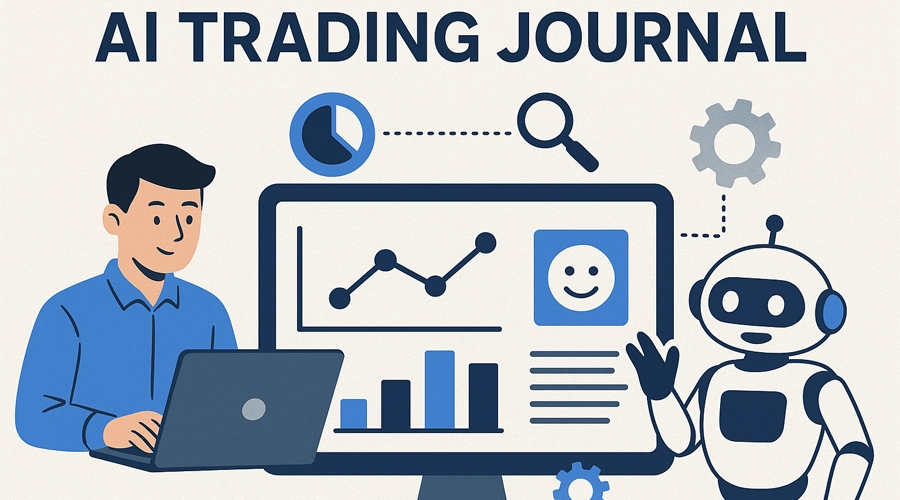
Pros, Cons, and Common Misconceptions About AI Journaling
Before jumping fully into the world of AI journaling, it’s essential to weigh the upsides, the limitations, and a few myths that might cloud your expectations. Like any tool, it’s most effective when you know what it can—and can’t—do.
✅ Pros of AI Journaling
- Time Efficiency: No more hours spent analyzing charts or flipping through notes. AI does the heavy lifting.
- Objective Analysis: AI doesn’t get tired, biased, or emotional — it tells you the truth based on patterns and data.
- Deeper Self-Awareness: Sentiment tracking reveals emotional triggers and behavioral blind spots.
- Better Decision-Making: With clearer patterns and historical insights, you can make smarter, faster calls.
- Personalized Feedback Loops: AI adapts to your style and gives tailored suggestions for improvement.
⚠️ Cons and Limitations
- Dependence Risk: Relying too heavily on AI might weaken your critical thinking over time.
- Data Quality Matters: Garbage in, garbage out. If your entries are vague, AI insights will be weak.
- Not Always Context-Savvy: AI may miss the nuance of news events, sudden market shocks, or non-verbal cues.
- Privacy Concerns: Some platforms store sensitive trading data. Always vet their data policies.
🚫 Common Misconceptions
- “AI journaling will trade for me.” → No, it’s a support system, not a trading bot.
- “It’s only for pros.” → In reality, beginners gain tremendous value by understanding their habits early.
- “All AI tools are the same.” → Not true. Features, UX, accuracy, and philosophy vary widely.
- “AI will eliminate all human error”. → It reduces error, but can’t replace discipline or sound judgment.
Get instant insights with ARYAMERX’s AI Trading Chatbot. Ask. Analyze. Act — smarter decisions start with smarter answers.
Final Thoughts: The Future of AI Journaling
The future of AI journaling isn’t just about efficiency or automation — it’s about building a deeper connection with your trading behavior, learning from it, and evolving faster than ever before.
As AI continues to advance, we can expect even more intelligent features:
- Real-time emotional feedback during trades
- Predictive analysis based on global news and your past behavior
- Voice-based journaling with instant categorization
- Integration with smart assistants for daily strategy briefings
But even with all this, the trader remains at the center.
The fundamental transformation happens not just when data is analyzed, but when you, the trader, act on it, when you reflect before reacting, when you identify not just what went wrong, but why, that’s the power of mindful, tech-assisted growth.
AI journaling is not a replacement for self-discipline or wisdom — it’s a mirror. One that helps you see yourself more clearly with every trade.
So, whether you’re a beginner just starting to track your trades or an advanced trader seeking performance breakthroughs, the message is clear:
Don’t just journal. Journal smart.
Analyze your trade journals using AI.


