
In trading, identifying the optimal entry and exit points in the market is crucial for success. These decisions determine when to buy and sell assets, aiming to maximize profits and minimize losses. A perfect entry or exit point can significantly impact a trader’s performance, while a misstep can result in missed opportunities or losses. While experience and market understanding play a role, pinpointing these moments is often challenging.
As markets become more complex and volatile, Artificial Intelligence (AI) is becoming increasingly relevant in the trading industry. AI provides data-driven insights that enable traders to make smarter, more informed decisions about when to enter or exit a market. By utilizing AI-powered algorithms, traders can rapidly analyze vast amounts of data, thereby eliminating the guesswork from decision-making. AI is transforming the way traders approach market analysis, offering more reliable and timely strategies. In this article, we’ll explore how AI detects market entry and exit points and enhances trade decisions.
Understanding Market Entry & Exit Points
What are Market Entry and Exit Points in the Context of Trading?
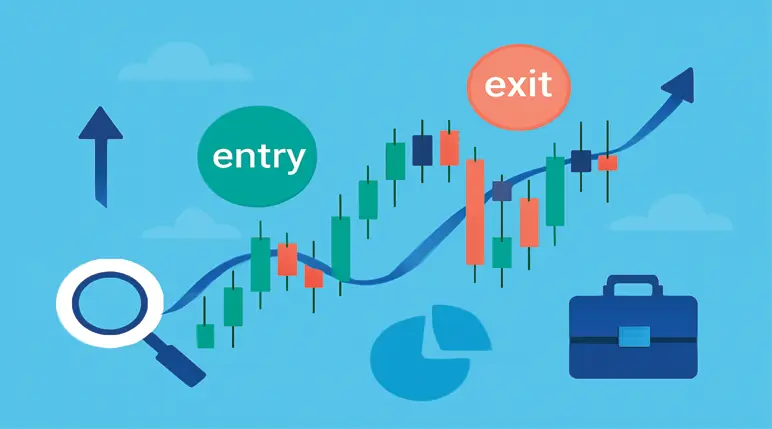
In the context of trading, market entry and exit points refer to the specific moments in time when a trader decides to buy or sell an asset. These decisions are crucial because they can significantly impact the trader’s overall performance and profitability.
- Market Entry Point: This is the moment a trader decides to enter a position, meaning they purchase an asset or investment. An entry point is determined based on various factors, including market conditions, price movements, technical indicators, and fundamental analysis. The goal is to enter the market at a price that maximizes profit.
- Market Exit Point: This is the point at which a trader decides to sell or close a position. The exit point is typically based on a price target, the realization of profit, or the stop-loss level to limit potential losses. It’s the moment when a trader decides to leave the market, either by selling a profitable asset or cutting their losses if the market moves unfavorably.
Both of these points are critical in trading as they define the effectiveness of a trade. Without a proper understanding of entry and exit points, traders may end up entering the market too early or too late, or fail to exit at the optimal time, leading to either missed profits or significant losses.
Why Are They Critical to Successful Trading Strategies?
The ability to accurately identify market entry and exit points is one of the most significant factors in determining the success of a trading strategy. Here are a few reasons why these points are so crucial:
- Maximizing Profits: By entering at the right time and exiting when prices peak or hit the desired target, traders can maximize their profits. The difference between entering early enough to capitalize on a rally and leaving before the market turns can be substantial.
- Minimizing Losses: Knowing when to exit a position is just as important as knowing when to enter. Exiting a trade before further losses can accumulate is a key part of risk management. Stop-loss orders are often used to help traders cut losses at a pre-determined level.
- Timing the Market: Markets can be highly volatile, and effectively timing entry and exit points can help traders benefit from market movements while minimizing unnecessary risk. Proper market timing enables traders to capitalize on favorable conditions and avoid unfavorable ones.
- Risk Management: Setting appropriate entry and exit points allows traders to manage their risk exposure. For example, entering a trade after a price correction and setting an exit strategy based on a favorable risk-to-reward ratio can help keep losses manageable.
In essence, the ability to identify optimal market entry and exit points is central to developing an effective trading strategy. It requires deep market knowledge, technical skill, and emotional discipline.
The Challenges of Manually Identifying the Right Points
While identifying market entry and exit points seems straightforward in theory, in practice, it can be highly challenging. Here are some of the key challenges traders face when attempting to do this manually:
- Market Volatility: The financial markets are constantly fluctuating, making it challenging for traders to predict the optimal time to enter or exit accurately. Sudden price movements, news events, or macroeconomic factors can create unpredictable market conditions that complicate decision-making.
- Emotional Bias: Many traders struggle with emotional decision-making, especially when faced with rapid market changes. Greed, fear, and hope can cloud judgment, leading traders to make impulsive decisions rather than following a structured plan.
- Lack of Real-Time Data: Manually analyzing the market can be time-consuming and requires access to current and accurate information. Traders who are unable to analyze data in real-time may miss key entry or exit points, especially when market conditions shift rapidly.
- Inconsistent Analysis: Humans are prone to inconsistencies in their analysis, especially under stress. Even experienced traders may struggle to make accurate predictions due to the complexity of market conditions and the numerous variables that must be taken into account.
- Overwhelming Data: Financial markets generate an overwhelming amount of data from various sources, including technical indicators, price charts, economic reports, and news updates. Filtering through all of this data to identify the correct entry or exit point can be an arduous and error-prone process.
- Human Error: Despite their best efforts, traders are vulnerable to making mistakes, whether it’s misinterpreting data, reacting too slowly, or overlooking critical information. Manual analysis leaves room for human error, which can lead to poor trades and missed opportunities.
Given these challenges, many traders are turning to AI-driven algorithms to help automate and improve the process of identifying market entry and exit points. AI systems can quickly process vast amounts of data, spot patterns, and offer data-driven insights that significantly reduce human error and emotional bias, leading to more informed and timely decisions.
The Role of AI in Detecting Market Entry & Exit Points
Explanation of how AI models use historical data, patterns, and real-time market information
AI models play a pivotal role in detecting market entry and exit points by leveraging vast amounts of historical and real-time market data. These models use historical data to recognize trends, fluctuations, and patterns that have previously occurred under similar conditions. By analyzing this data, AI can identify recurring patterns that precede significant price movements, such as bullish or bearish trends. This data-driven approach enables AI systems to identify signals that indicate when the market is about to shift, allowing traders to make well-timed decisions.
In addition to historical data, AI models incorporate real-time market information, which includes live price movements, volume changes, social media sentiment, news updates, and economic reports. By processing this dynamic information, AI systems can detect sudden changes in market conditions and adjust their predictions accordingly. The combination of historical data and real-time inputs ensures that AI provides up-to-date, context-aware market insights, enabling traders to respond quickly to changes in the market environment.
How AI-driven algorithms analyze market conditions to predict entry and exit points
AI-driven algorithms excel in analyzing complex and ever-changing market conditions. Through advanced algorithms, these models identify signals that point to optimal market entry and exit points. AI systems typically rely on techniques such as technical analysis and quantitative modeling to assess various factors, including price momentum, market volume, volatility, and other key indicators.
For example, AI can analyze price action patterns such as support and resistance levels, candlestick formations, and moving averages to determine potential entry or exit signals. These systems also take into account market volatility to assess the risk of entering or exiting at specific times, ensuring that trades are made with an understanding of market stability or unpredictability.
By processing vast amounts of data at once, AI algorithms can identify entry points when the market is poised for a favorable movement and exit points when the market is likely to reverse or lose momentum. This ensures that traders are more likely to buy low and sell high, maximizing potential profits while minimizing risk.
The significance of machine learning and deep learning in improving AI predictions
Machine learning (ML) and deep learning (DL) are central to the improvement of AI predictions for market entry and exit points. Machine learning allows AI models to “learn” from historical data without being explicitly programmed for every scenario. By continuously processing data and identifying patterns, ML algorithms can improve their predictions over time. As they encounter new data, these algorithms refine their models, adjusting their predictions to accommodate changing market conditions and emerging patterns.
Deep learning, a more advanced form of machine learning, takes this a step further by utilizing neural networks that mimic human brain processes. Deep learning models can process highly complex and unstructured data, such as text from news articles or social media, along with traditional numerical data. This enables AI to incorporate factors such as public sentiment and geopolitical events, which can significantly impact market movements. Deep learning models are particularly effective at detecting intricate, non-linear relationships within data, which can be challenging for humans or simpler algorithms to identify.
Both machine learning and deep learning empower AI to improve the accuracy of its predictions over time. As these models are exposed to more data, they develop a deeper understanding of market dynamics, enabling them to offer increasingly reliable predictions for market entry and exit. This capability gives traders a distinct advantage, as they can make informed decisions based on data-backed insights rather than relying on intuition or guesswork.
In summary, AI-driven algorithms combine historical data, real-time information, and advanced technologies such as machine learning and deep learning to enhance the detection of market entry and exit points. These AI tools provide traders with precise, timely, and actionable insights, enabling them to make smarter, more informed trading decisions that can lead to greater market success.

AI Techniques for Identifying Key Market Entry & Exit Points
In today’s fast-moving financial markets, the ability to detect key market entry and exit points can significantly improve a trader’s performance. With the help of AI, traders can identify these points with a level of precision that manual analysis simply can’t match. Here are some of the most powerful AI techniques used to detect the optimal moments for entering or exiting the market:
1. Time-Series Analysis and Its Application in Predicting Trends
Time-series analysis is one of the most widely used techniques in trading, and AI has taken it to the next level. Time-series data involves analyzing a series of data points, usually prices, over a specific time interval. By applying machine learning algorithms to historical price data, AI can identify underlying trends and forecast future price movements.
- Trend identification: AI models can recognize long-term upward or downward trends, enabling traders to determine the optimal time to enter or exit a trade.
- Seasonality patterns: Some markets exhibit recurring cycles or seasonality, such as higher volatility during certain months or specific times of the day. AI can identify these patterns to help predict the most favorable times for trading.
- Moving averages and lagging indicators: AI can enhance traditional technical indicators, such as moving averages or MACD (Moving Average Convergence Divergence), to identify when trends are strengthening or losing momentum, providing entry or exit signals.
By continuously monitoring time-series data, AI enables traders to respond to emerging trends quickly, thereby maximizing profits and minimizing risk.
2. The Role of Sentiment Analysis in Assessing Market Mood and Deciding When to Enter or Exit
Market sentiment plays a crucial role in the behavior of asset prices. Sentiment analysis is an AI technique that helps determine the overall mood of the market—whether it is optimistic or pessimistic—by analyzing news articles, social media, financial reports, and other textual data sources.
- Text mining: AI can analyze news articles, tweets, or forum discussions to gauge public opinion on a particular asset or the broader market. Positive sentiment can signal a good entry point, while negative sentiment might indicate an optimal time to exit.
- Predicting market reversals: When sentiment becomes overly bullish or bearish, it may indicate that a market reversal is imminent. AI models can detect such sentiment extremes and alert traders to potential entry or exit opportunities before the crowd reacts.
- Real-time updates: Unlike human traders, AI can process large volumes of unstructured data in real-time, providing insights into how shifts in sentiment are affecting asset prices and offering traders timely information on whether to enter or exit the market.
By combining sentiment analysis with price action, AI enables traders to make more informed decisions based on a comprehensive view of market dynamics, rather than relying solely on numbers and charts.
3. Pattern Recognition through AI to Identify Repetitive Market Behaviors
Pattern recognition is a key area where AI excels. By utilizing advanced algorithms, AI can analyze historical price data and identify recurring market patterns that have consistently led to successful trades in the past. These patterns can include:
- Chart patterns: Classic patterns like head and shoulders, triangles, and flags that traders use to identify potential reversals or continuation trends. AI algorithms can quickly identify these formations and alert traders to potential market movements.
- Candlestick patterns: AI can be trained to recognize specific candlestick formations, such as engulfing patterns or doji formations, that indicate a shift in market sentiment, potentially signaling good entry or exit points.
- Behavioral patterns: AI can also analyze behavioral data, such as how certain assets respond to economic events or earnings reports. If the price of an asset behaves similarly following a specific event in the past, AI can predict similar outcomes in the future.
By detecting repetitive market behaviors and historical patterns, AI enables traders to adopt a systematic approach to identifying entry and exit points, thereby helping them avoid emotional decision-making and reduce the risks associated with manual analysis.
4. Use of Predictive Analytics and Quantitative Models in Forecasting Market Movement
One of the most powerful applications of AI in trading is its ability to make predictions about future price movements. AI models can analyze vast amounts of historical data combined with real-time market conditions to develop highly accurate forecasts. Predictive analytics uses a range of techniques to forecast market behavior, including:
- Regression models: AI uses regression techniques to understand the relationship between various factors that influence asset prices. This helps predict future price movements based on these relationships.
- Monte Carlo simulations: By running simulations on future price movements, AI can provide a range of potential outcomes, allowing traders to assess the probability of different price scenarios and make more informed decisions.
- Quantitative models: AI integrates statistical arbitrage, factor models, and other quantitative strategies to develop algorithms that predict optimal market entry and exit times. These models analyze market inefficiencies and identify pricing discrepancies that traders can exploit for profit.
Predictive analytics not only improves the accuracy of identifying market entry and exit points but also allows traders to adopt a more scientific approach to trading. By using quantitative data to guide decisions, AI minimizes the reliance on intuition and reduces the risk of making subjective, emotional decisions.
These AI techniques—time-series analysis, sentiment analysis, pattern recognition, and predictive analytics—are transforming how traders identify market entry and exit points. With the ability to analyze vast amounts of data quickly and accurately, AI provides traders with valuable insights that can help them make smarter, more informed trade decisions, ultimately leading to greater profitability in the markets.

Advantages of Using AI for Market Entry & Exit Points
- Speed
In the world of trading, time is money. Markets can move quickly, and decisions need to be made within seconds to capitalize on opportunities. AI has the remarkable ability to process and analyze vast amounts of data at incredible speeds, far surpassing human capabilities. By utilizing AI for market entry and exit points, traders can make informed, real-time decisions based on up-to-the-minute data, eliminating delays. This speed ensures that opportunities aren’t missed and trades are executed at optimal moments. - Accuracy
Human decision-making is often influenced by biases and emotions, which can lead to errors in judgment. With AI, traders can eliminate these human factors and rely on data-driven insights. AI models are designed to analyze patterns, historical data, and real-time information, ensuring that entry and exit points are identified with a high level of accuracy. These models don’t succumb to impulsive decisions, providing traders with more reliable signals to buy or sell. - Adaptability
The market is constantly evolving, and staying ahead of these changes is critical for success. One of the key advantages of AI is its ability to learn from new data continually. As market conditions shift, AI models adapt and refine their predictions to align with current trends. This ability to learn and evolve in real-time ensures that AI remains relevant, providing updated predictions based on the latest market movements. Traders can trust that their AI-driven insights are always aligned with the most current market conditions, reducing the risk of outdated strategies. - Automation
Trading decisions are often influenced by emotions such as fear or greed, leading to poor judgment and impulsive actions. With AI, traders can reduce the impact of these emotional factors by relying on automated trading systems. Once the AI detects a strong market entry or exit point, it can automatically execute the trade without any input from the trader. This level of automation not only removes emotional biases but also ensures that trades are executed at optimal moments, following the rules set by the trading strategy. Furthermore, automation can save time, allowing traders to focus on refining their strategy or other aspects of their business while the AI handles trade execution.
In summary, AI provides a significant edge in detecting and acting on market entry and exit points, offering speed, accuracy, adaptability, and automation. These advantages enable traders to make smarter, data-driven decisions while reducing the risks associated with emotional trading and human error.
Challenges of Relying on AI for Trade Decisions
While AI provides powerful tools for detecting market entry and exit points, it is not without its challenges. Understanding these limitations is crucial for traders who rely heavily on AI-driven strategies. Here are the key challenges:
- Overfitting of Models
One of the main challenges of using AI for trading decisions is the risk of overfitting. This occurs when an AI algorithm adapts too closely to historical data, often fine-tuning itself to patterns and noise specific to that data. As a result, the model may perform exceptionally well on past data but fail to generalize to new, unseen data. This is particularly problematic in trading, where market conditions are constantly evolving. Overfitting leads to models that are overly complex and not flexible enough to react to new trends or market shifts, ultimately reducing their reliability for real-world decision-making. - The Need for Regular Model Updates
Markets are highly dynamic, influenced by a multitude of factors, including economic reports, geopolitical events, and shifting investor sentiments. To remain effective, AI models need to be updated regularly to account for these shifts. Market conditions evolve, and a model trained on historical data can quickly become outdated if it is not refreshed with the latest information. Traders must ensure that their AI systems are regularly recalibrated and retrained to adapt to current market conditions. Failure to do so can lead to inaccurate predictions and poor trade decisions, especially in the face of sudden market disruptions. - The Risk of False Positives/Negatives
Even though AI can process vast amounts of data at impressive speeds, it is not immune to making mistakes. One significant issue is the risk of false positives and false negatives. A false positive occurs when AI predicts a favorable entry or exit point that ultimately proves to be unprofitable, leading traders to take actions that result in losses. On the other hand, a false negative occurs when AI fails to identify a valuable trade opportunity, resulting in traders missing out on potential profits. These errors can be particularly pronounced in volatile markets, where market conditions change rapidly, making it harder for AI to make accurate predictions. The risk of these mistakes increases when the data being analyzed is noisy or incomplete, or when market patterns suddenly deviate from historical norms.
In conclusion, while AI in trading offers numerous advantages, these challenges underscore the importance of utilizing AI tools in conjunction with human judgment and continuous oversight. Traders must be aware of the limitations of AI and implement safeguards to ensure that their market entry and exit decisions remain accurate and adaptable in an ever-changing market environment.

AI in Real-World Trading Applications
AI has already begun transforming the trading landscape by providing powerful tools that help traders and investors make more informed decisions. AI-driven insights have become crucial in accurately predicting market entry and exit points, offering advantages like speed, precision, and adaptability. In this section, we’ll explore how AI is being utilized in real-world trading applications and how traders can incorporate AI into their strategies.
Examples of Platforms and Tools that Use AI for Market Entry and Exit Predictions
Several leading platforms and tools are now leveraging AI to enhance the trading experience, making it easier for traders to make informed decisions based on real-time data and predictions. Here are a few key examples:
- MetaTrader 4 and 5 (MT4/MT5) with AI Plugins
MetaTrader is one of the most widely used trading platforms among forex traders and investors. While the platform itself does not come with built-in AI capabilities, third-party AI plugins and bots can be integrated. These plugins analyze historical data and provide predictions for market entry and exit. By applying machine learning techniques, these bots can identify patterns, suggest optimal entry and exit points, and even execute trades automatically. - TradeStation
TradeStation is a platform designed for both professional and retail traders, offering AI-powered trading features. Through its RadarScreen tool, TradeStation allows traders to monitor real-time market data and receive AI-generated signals for potential entry and exit points. The platform uses advanced algorithms to analyze millions of data points and provides suggestions based on current market conditions and past trends. Traders can set alerts or even automate trades based on AI recommendations. - QuantConnect
QuantConnect is an open-source algorithmic trading platform that integrates AI and machine learning to help traders create and backtest strategies. Traders can utilize QuantConnect’s extensive data library and AI models to develop customized strategies that pinpoint market entry and exit points. The platform is especially popular among quantitative traders who seek to implement AI-driven trading systems that operate based on predictive analytics. - AlgoTrader
AlgoTrader is another platform that focuses on automated trading strategies. It utilizes AI algorithms to analyze market data and provide signals for optimal entry and exit points. AlgoTrader also integrates with various trading platforms, allowing traders to deploy fully automated trading strategies based on AI insights. With its extensive backtesting capabilities, traders can refine their strategies before executing them in a live environment. - Upstox AI
Upstox is an emerging trading platform that leverages AI-powered insights to predict market entry and exit points in real-time. Through Upstox AI, traders can receive personalized recommendations based on real-time market data and historical trends. The platform enables traders to closely monitor market behavior and adjust their strategies based on AI-driven insights.
How Traders and Investors Can Incorporate AI-Driven Insights into Their Daily Trading Strategies
While AI tools are powerful, integrating them into daily trading practices requires careful consideration and strategic planning. Here’s how traders and investors can effectively incorporate AI-driven insights into their trading routines:
- Automate Entry and Exit Decisions with AI Trading Bots
One of the easiest ways to integrate AI into daily trading is by using AI trading bots. These bots are programmed to make market entry and exit decisions automatically based on real-time data analysis. Traders can set parameters such as risk tolerance, asset preferences, and trade volume, and the bot will execute trades accordingly. This is particularly beneficial for busy traders who cannot continuously monitor the markets. AI bots ensure that decisions are made in line with pre-defined strategies and without human emotional interference. - Use AI for Predictive Analysis and Alerts
Traders can use AI-powered predictive analytics tools to stay ahead of market movements. These tools analyze massive amounts of data, including historical trends, economic indicators, and social media sentiment, to predict potential price movements. Traders can set alerts to receive notifications when specific market entry and exit points are approaching. This allows traders to react in real-time and adjust their strategies accordingly. - Enhance Risk Management with AI
Risk management is a crucial part of any trading strategy, and AI can help enhance risk management. AI-driven tools can assess a trader’s portfolio, calculate potential risks, and provide insights into how to minimize them. For example, suppose an AI algorithm detects that the market is about to enter a volatile phase. In that case, it might recommend reducing exposure to certain assets or suggest new entry and exit points that align with the market’s changing dynamics. - Backtest AI Strategies Before Live Trading
One of the key advantages of using AI in trading is the ability to backtest strategies using historical data. Traders can test how well an AI algorithm would perform under different market conditions before committing to real-time trading. Platforms like QuantConnect enable traders to simulate trades, analyze the results, and refine their strategies for improved future performance. Backtesting provides confidence that the AI models are accurate and reliable. - Diversify Trading Strategies Using Multiple AI Tools
Rather than relying on a single AI tool, traders can diversify their strategies by incorporating multiple platforms and models. For example, combining predictive models from one AI platform with pattern recognition from another can help traders cover a broader range of market aspects. This diversified approach increases the likelihood of identifying the optimal market entry and exit points. It reduces reliance on a single tool that may not be effective in all market conditions. - Leverage AI Insights for Long-Term Investments
While AI in day trading is widely recognized, it can also be applied to long-term investment decisions. Traders can rely on AI to evaluate macroeconomic trends, industry movements, and long-term price patterns, identifying stocks, assets, or commodities that are poised for growth. By incorporating AI-driven insights, investors can adjust their portfolios to optimize long-term returns in response to evolving market conditions. - Monitor AI Recommendations with Human Judgment
AI-driven insights can be compelling, but they should not be followed unthinkingly. Traders should constantly monitor AI recommendations and use their judgment to assess whether the AI insights align with their understanding of the market. AI is a tool, not a decision-maker, and human oversight is crucial to ensure that trades align with the trader’s goals and risk tolerance.
Conclusion
In this article, we explored the role of AI in detecting market entry and exit points and how it is revolutionizing the way traders make decisions.
As the trading world becomes increasingly complex and volatile, relying on AI-driven insights has become essential for making informed, data-backed decisions. From platforms like MetaTrader and TradeStation to advanced AI-powered tools like QuantConnect, traders now have access to powerful resources that analyze vast amounts of data in real-time, providing accurate predictions on market entry and exit points.
Incorporating AI into daily trading strategies offers several key benefits, including faster decision-making, improved accuracy, enhanced risk management, and the ability to automate trades. With predictive models, sentiment analysis, and real-time alerts, AI enables traders to make informed decisions, free from the emotional biases that often cloud human judgment.
However, integrating AI into trading presents its challenges. Overfitting models, the need for regular updates, and potential false signals are among the obstacles that traders must navigate. Despite these challenges, AI provides traders with the tools they need to stay ahead of the market and optimize their strategies for better profitability.
As we’ve seen, AI in trading applications is already having a significant impact on market analysis and decision-making. Whether you are a seasoned trader or just starting, incorporating AI-driven insights into your trading routine can give you a competitive edge, enabling you to make smarter market entry and exit decisions that align with your goals. By embracing AI, traders can harness the power of data to unlock smarter, more efficient trading strategies that ultimately lead to success in the ever-evolving financial markets.


