Imagine this: it’s 9:30 a.m. The markets open, volatility spikes, and within milliseconds, algorithms have already placed thousands of trades—scanning global headlines, analyzing price patterns, and executing decisions before a human even finishes their morning coffee. Welcome to the age of AI trading.
But hold on. Somewhere across the globe, a human trader, eyes on the screen, gut tuned to years of market experience, pauses before entering a trade—not because of numbers, but because of something subtler. A feeling. A memory. A pattern they’ve seen in chaos before.
This silent battle between AI trading vs human trading is becoming one of the most fascinating—and high-stakes—questions in modern finance. Can machines outsmart the instincts of seasoned traders? Or is human intuition still king when it comes to surviving the unpredictable tides of the market?
In this article, we’re diving deep into the unique strengths and weaknesses of both sides. We’ll look beyond the surface-level comparisons and explore how AI’s decision-making power stacks up against human strategy, emotion, and adaptability. Whether you’re a curious newcomer, a swing trader juggling market news, or a tech-savvy investor intrigued by trading bots, this is your field guide to understanding who does it better—and why the answer may not be as simple as you think.
Understanding the Core: What Is AI Trading and How Does It Work?
In today’s rapidly evolving markets, speed and data reign supreme. That’s where AI trading steps in—not just as a tool, but as a game-changer. But let’s take a step back. What exactly is AI trading, and why is everyone from hedge funds to solo traders talking about it?
🚀 The Core of AI Trading
AI trading, also known as algorithmic trading powered by artificial intelligence, involves the use of machine learning models, predictive analytics, and vast datasets to make trading decisions with minimal human intervention. Unlike traditional algorithmic trading, which follows hard-coded rules, AI trading is dynamic—it learns, adapts, and evolves.
Imagine a system that doesn’t just follow a moving average crossover but analyzes millions of data points, interprets news sentiment, tracks social media trends, and even monitors macroeconomic indicators—all in real-time. That’s not sci-fi; it’s how modern AI-based trading systems operate today.
🧠 How Does It Work?
Let’s simplify the process without dumbing it down:
- Data Ingestion
The process begins by feeding the AI with vast volumes of structured and unstructured data. This includes:- Historical price charts
- Real-time market feeds
- News articles
- Tweets, Reddit threads, and financial reports
These data sets become the fuel for training the AI’s brain.
- Machine Learning Models
Through machine learning algorithms—often deep learning or reinforcement learning—the AI identifies patterns and correlations that human traders might overlook. For example:- If oil prices rise and certain tech stocks fall 78% of the time, it picks that up.
- It doesn’t “assume”; it learns from the data itself.
- Signal Generation
The AI generates buy or sell signals based on the probabilities derived from its models. These aren’t guesses—they’re calculated decisions based on statistical confidence and backtested logic. - Execution Algorithms
Once a signal is generated, AI-powered bots can execute trades instantly. They employ innovative execution strategies, such as TWAP (Time-Weighted Average Price) and VWAP, as well as liquidity-seeking algorithms, to minimize slippage and transaction costs. - Feedback Loop (Learning from Mistakes)
Here’s the magic: AI doesn’t stop learning. It evaluates the outcomes of its trades, measures performance, and refines its models. Over time, the system becomes smarter, much like a trader who improves after every session, albeit much faster.
⚙️ Key Technologies Behind AI Trading
To genuinely appreciate AI trading vs human trading, it’s essential to understand the backbone of these systems:
- Natural Language Processing (NLP): Used for scanning news, earnings reports, and even Elon Musk’s tweets.
- Sentiment Analysis: Detects market mood swings based on tone and keywords.
- Big Data Processing: Handles enormous datasets in milliseconds.
- Cloud Infrastructure & APIs: Enables scalability and integration with brokers, exchanges, and analytics platforms.
💡 Why Does It Matter?
Because AI doesn’t sleep, it doesn’t panic during volatile markets. It doesn’t chase losses. For many, these traits make it look superior to human trading. But as we’ll explore later, trading is not just math—it’s also art, instinct, and psychology. And that’s where the human still holds power.
The Human Edge: What Human Traders Bring to the Table
In the age of lightning-fast AI trading algorithms, it’s easy to underestimate the value of the human mind. But beneath all the hype of neural networks and machine learning models lies something no machine has yet mastered — intuition. When it comes to AI trading vs human trading, humans still bring irreplaceable strengths to the table.
1. Intuition Can’t Be Coded
While AI can crunch millions of data points in seconds, it still lacks a proper understanding of context. A seasoned human trader, on the other hand, can glance at a chart and sense a shift — a pattern forming, a market breathing differently. They don’t just read numbers. They feel the market’s mood.
That gut feeling, built from years of experience, isn’t magic. It’s pattern recognition, too — just not the kind powered by silicon. It’s formed through failure, success, and the subtle nuances that no dataset can fully capture.
2. Adapting to the Unpredictable
Markets are emotional, chaotic, and often irrational — just like people. Unexpected news, political turmoil, or a viral tweet can change everything in seconds. While AI trading systems struggle to process unstructured, real-time chaos, human traders excel at making quick decisions under pressure.
A human can instantly evaluate whether news is noise or a game-changer. They can weigh the credibility of the source, understand cultural implications, and adjust their strategy on the fly. That’s a kind of adaptability that AI still struggles with.
3. Risk-Taking and Creativity
AI trading bots are designed to be risk-averse. They stick to patterns, follow rules, and minimize error. But sometimes, success in trading means breaking the rules — taking a calculated risk based on a bold insight. Human traders can spot asymmetric opportunities where risk is low, but reward is massive, even if the model says “no trade.”
Humans also experiment. They build new strategies, challenge old models, and think outside the algorithmic box. This creative edge is what leads to breakthroughs, not just in trading but in the evolution of markets themselves.
4. Emotional Awareness (Yes, It Helps)
Emotions often receive a bad reputation in trading — fear, greed, and overconfidence — but when managed effectively, they can be powerful tools for success. A trader aware of their emotional state can use it to their advantage. They can sense when the crowd is euphoric or panicked, and trade against the tide.
AI doesn’t “feel” fear, but it also can’t sense it in others. Humans can. They can read between the lines of price action, volume spikes, or sudden reversals and interpret what others might be thinking, before it becomes obvious.
5. Moral and Ethical Judgment
Trading isn’t always numbers. There are moments when ethics, compliance, or long-term reputation come into play. Should I front-run this trade? Should I profit from a company that’s about to go bankrupt? AI doesn’t ask those questions. But a human might — and often, should.
In AI trading vs human trading, moral responsibility still lies with the human. That alone is a reason not to outsource decision-making to machines fully.
While AI trading systems offer speed, scale, and precision, human traders bring something less tangible — but just as powerful. They bring judgment, emotion, creativity, and a capacity to read between the lines. In a world obsessed with automation, the human edge may just be the secret weapon.
🚀 Speed vs. Strategy: Comparing Decision-Making Power
When it comes to AI trading vs human trading, one of the hottest debated aspects is decision-making power. On paper, machines win in speed—no question. But is faster always better? Let’s dig deeper.
⚡ Speed: The AI Advantage
AI trading systems thrive on speed. With access to real-time market data, they can analyze thousands of data points, detect micro-trends, and execute trades in milliseconds. For example:
- High-frequency trading (HFT) algorithms can execute hundreds of trades per second.
- AI bots monitor dozens of indicators simultaneously—RSI, moving averages, candlestick patterns—without blinking.
This kind of real-time data analysis is impossible for a human. The sheer processing power of AI allows it to catch opportunities long before a human trader could even open a chart.
But here’s the catch: fast decisions aren’t always smart decisions.
🧠 Strategy: The Human Perspective
Human traders excel at strategic thinking. They understand context. While AI might pick up on a price breakout, a human might pause and ask, ‘Do fundamentals support this move?’ Or is it just noise?
Humans can consider:
- The tone of a central bank speech.
- Upcoming geopolitical events.
- Insider sentiment or market psychology.
These aren’t easily quantifiable, and most AI trading algorithms don’t process such nuanced signals effectively (yet).
Moreover, strategic decision-making often requires stepping back from the screen, zooming out, and thinking beyond the data presented in the chart. That’s where human intuition shines. Strategy isn’t about acting fast; it’s about acting right.
🎯 The Real Question: What Kind of Trader Are You?
If your goal is to scalp tiny profits all day, speed is king, and AI might outperform. But if you’re building a long-term position or analyzing macroeconomic shifts, strategy beats speed.
In essence:
- AI trading = Reaction-based, lightning-fast, great for repetition.
- Human trading = Thought-driven, slower-paced, ideal for complex market scenarios.
In the battle of speed vs. strategy, it’s not about which one is superior—it’s about which one fits your trading style and goals. Fast doesn’t always mean effective. And slow doesn’t mean weak. The best traders know when to be quick and when to be wise.

Emotions, Biases, and Behavior: The Double-Edged Sword of Human Trading
Let’s face it—trading isn’t just numbers and charts. It’s psychological warfare, and the battlefield is often inside our heads. No matter how many strategies a human trader masters, emotions tend to sneak in and stir the pot. Fear of missing out (FOMO), panic selling, overconfidence after a lucky win—sound familiar?
That’s where human trading both shines and stumbles.
Humans can read between the lines. A seasoned trader might catch the subtle tone shift in a CEO’s voice during an earnings call or sense an upcoming market shakeout just from a pattern of social media buzz. This intuitive edge is potent, but it comes with baggage: cognitive biases.
Here are a few common culprits:
- Confirmation Bias: You tend to seek data that supports your initial instinct and overlook potential red flags.
- Loss Aversion: You hold onto a tanking asset longer than you should, just to avoid accepting defeat.
- Herd Mentality: You jump into a trade just because “everyone else is doing it.”
These mental shortcuts evolved to help us survive—but in the lightning-fast world of markets, they can be costly.
Enter: AI trading systems.
They don’t flinch. They don’t dream. They don’t care if Bitcoin just broke your heart last week. AI trading algorithms make decisions based on historical data, probability, and pattern recognition—not on a sleepless night or a rumor on Reddit.
That emotional detachment is precisely what makes AI-driven trading so compelling to many investors. There’s no room for panic during a crash or overexcitement in a bull run—just clean, calculated execution.
But does this make AI better?
Well, not always. Sometimes, emotion is information. For instance, if markets are driven by panic, a skilled human trader might sense the shift in sentiment early, even before the numbers indicate it. AI, trained only on past patterns, may fail to recognize these emotional undercurrents, mainly when black swan events occur.
In other words, where AI trading offers stability and consistency, human trading offers context and instinct.
If trading were a chess game, AI would be the cold, calculated grandmaster—flawless in pattern, blind to emotion. The human, on the other hand, might make a bold, unpredictable move that changes the game entirely. Sometimes brilliant, sometimes reckless.
And maybe—just that’s why the most powerful strategy isn’t choosing sides, but finding balance between machine precision and human insight.

Backtesting & Pattern Recognition: AI’s Superpower
When it comes to AI trading vs human trading, one of the most striking advantages of artificial intelligence is its unmatched ability to spot patterns and test them. We’re talking about a kind of pattern recognition that no human, no matter how experienced, could replicate at scale.
Imagine a trader with a perfect memory who can recall and analyze millions of past market movements in mere seconds. That’s what an AI-powered system is designed to do. Through machine learning algorithms, it learns from historical price data, identifies profitable setups, and continuously refines its models without fatigue, ego, or emotion.
However, it doesn’t stop at identifying candlestick patterns or trendlines. AI trading tools can uncover multi-variable correlations that are invisible to the human eye—connections between price action, volume, news sentiment, macroeconomic data, and even social media buzz. And once those patterns are identified, AI can backtest them across decades of data in minutes. No spreadsheets. No guesswork. Just raw, calculated insight.
Meanwhile, human traders often rely on memory, intuition, or their favorite strategy that “worked last year.” Backtesting for a human is manual, time-consuming, and prone to bias. We tend to cherry-pick data that supports our assumptions or ignore trades that don’t fit the story we want to believe.
Here’s the kicker: AI doesn’t just test what works—it tells you why and when it works best. It can simulate how a pattern performs during high-volatility markets, post-earnings sessions, or geopolitical events. This contextual intelligence makes AI not only faster but also more objective and adaptable.
Still, there’s a catch: AI doesn’t innovate—it iterates. It builds on the past. So, if the market enters uncharted territory, a purely data-driven model might stumble. That’s where the human brain’s abstract reasoning and “gut feel” shine.
But when it comes to backtesting and pattern recognition, let’s be honest—this round goes to the machines.

Adaptability and Intuition: Where Humans Still Win
In the high-speed world of AI trading vs human trading, algorithms often steal the spotlight with their lightning-fast execution and ability to crunch massive datasets in seconds. But here’s the twist: when the market turns unpredictable, it’s not always the machine that holds the upper hand. Human traders still excel where machines falter—especially in the gray zones of nuance, emotion, and raw intuition.
1. Humans See the Unwritten Stories
Markets aren’t just numbers. They’re reflections of politics, human psychology, economic whispers, and social shifts. A sudden CEO scandal, a viral tweet, or subtle geopolitical tension might not register as “relevant” in an AI trading model—but a human trader can connect the dots before the data catches up.
While AI trading systems rely on structured data and trained patterns, humans can sense what is about to become relevant. Call it instinct, gut feeling, or simply experience—but it’s real. It’s that quiet nudge that tells a trader, “Something’s off.”
2. Flexibility in the Face of Chaos
Imagine this: the market suddenly reacts to an unexpected announcement of war or a global pandemic. AI might freeze, misinterpret, or take milliseconds too long to recalibrate. Meanwhile, a seasoned human trader knows: step back, reassess, adapt. Humans can choose not to act, override emotional reactions, or even break their own rules when context demands it. That’s not a bug—it’s a strategic feature.
This kind of real-time adaptability is where the human brain still outperforms cold code. AI trading bots follow logic trees; humans can break them when logic collapses.
3. Navigating the Unknown Unknowns
AI thrives in repetition. Feed it enough past data, and it becomes an expert in forecasting repeatable patterns. But what about the “unknown unknowns”? The market events we haven’t seen before? The black swans?
In such cases, human traders can improvise. They can question the system, pivot mid-trade, or sense the emotional undercurrent of the market that no sentiment analysis model could fully decode.
4. The Role of Narrative Thinking
Storytelling matters—even in trading. While AI trading sees candle patterns, humans sometimes see meaning. Traders often frame markets as stories unfolding—bullish comebacks, breakdowns, revenge rallies. This narrative sense enables humans to construct mental models, envision future scenarios, and make decisions that don’t just rely on what was, but also on what could be.
AI trading vs human trading isn’t just about speed or stats—it’s also about context, emotion, and intuition. And in these deeply human territories, we still hold the edge. While machines might win the race in structured environments, it’s the flexible, intuitive, storytelling brain of a human that often wins in the wild.
Because let’s face it—trading isn’t always logical. And that’s precisely why humans still matter.
Case Studies: Real-World Examples of Success and Failure
When it comes to AI trading vs human trading, theory can only take us so far. What truly separates fiction from fact is how these systems — and people — perform in the wild, under pressure, with real money on the line.
Let’s zoom in on a few real-world scenarios that reveal the strengths and weaknesses of both camps:
✅ Success Story #1: Renaissance Technologies and the Power of the Machine
You can’t talk about AI-powered trading without mentioning Renaissance Technologies. The hedge fund, founded by mathematician Jim Simons, is famous for its Medallion Fund, which reportedly uses advanced machine learning models, pattern recognition, and quantitative strategies.
And the results? Mind-blowing.
The fund has delivered annualized returns of over 30% after fees. All this with minimal human intuition in the decision-making process. Trades are executed at lightning speed based on data-driven signals, far beyond what any human could digest or respond to in real-time.
🔍 What it shows: When designed and managed well, AI trading algorithms can outperform even the best human traders, especially in high-frequency, data-intensive environments.
❌ Failure Story #1: Knight Capital’s $440 Million Mistake
On the flip side, technology isn’t foolproof, and neither is automated trading.
In 2012, Knight Capital Group, one of the largest market makers in the U.S., experienced a catastrophic failure when a new automated trading system was deployed without proper testing. Within 45 minutes, a software glitch led the system to buy and sell millions of shares erroneously.
Result? A $440 million loss and near-bankruptcy.
🔍 What it shows: Speed without oversight is dangerous. AI trading bots need robust fail-safes and constant monitoring. Otherwise, they can spiral out of control much faster than any human could.
✅ Success Story #2: The Discretionary Trader Who Beat the Bots
During the COVID market crash of March 2020, many AI models struggled to cope with the chaos. Volatility was off the charts. Historical patterns broke. News sentiment shifted faster than algorithms could retrain.
Meanwhile, traders like Paul Tudor Jones — a legendary human discretionary trader — leaned into experience and gut instinct. He made massive gains by anticipating the Fed’s response and buying into the dip before most models had adjusted.
🔍 What it shows: In periods of black swan events, human trading analysis can adapt faster and smarter. AI may be blind to nuance; humans can read between the lines.
❌ Failure Story #2: The Emotional Retail Trader Trap
Let’s not romanticize human judgment either.
Retail traders on platforms like Robinhood or Binance often fall into the trap of emotional trading. One classic example: the GameStop short squeeze in early 2021. While some made fortunes, many more bought at the peak due to FOMO and lost thousands of dollars.
Contrast that with AI systems that don’t feel greed or panic. They stick to strategy.
🔍 What it shows: Emotion is a double-edged sword. It fuels creativity and intuition, but also poor decisions and herd behavior. AI trading avoids that noise.
In the debate of AI trading vs human trading, neither side has a flawless record. AI excels at scale, speed, and discipline. Humans thrive in chaos, relying on intuition and creative reasoning. But both can fail spectacularly — if not used wisely.
That’s why many top-performing hedge funds and trading firms are no longer asking “Who does it better?” but rather, “How can they work together?”

Hybrid Models: Why AI + Human Might Be the Future
In the ever-evolving landscape of financial markets, the question isn’t just “AI trading vs human trading” anymore. It’s shifting toward a more nuanced perspective: What if the real edge lies in combining the two?
While AI trading algorithms excel at processing massive datasets, spotting patterns, and executing trades in milliseconds, they often lack something vital — context. On the other hand, human traders bring intuition, emotional intelligence, and the ability to respond to nuance — elements that can be the difference between profit and panic during unexpected market shifts.
What happens when we combine machine logic with human instinct?
We have a hybrid trading model — a setup where AI-driven signals support human decision-making, and human oversight fine-tunes the machine’s output. It’s not man versus machine; it’s man with machine.
⚡ Why This Combo Works:
- Speed meets strategy: AI handles data crunching and identifies setups fast. The human adds context — is this a genuine breakout or just a fakeout?
- Emotion-proof, but not empathy-proof: While AI trading systems don’t panic-sell, they also don’t “feel” a crisis coming. Humans can read between the numbers, sense market sentiment, and adjust when things don’t go as planned.
- Learning from each other: Advanced machine learning models can be trained on the behavior of top traders. Meanwhile, traders using these models can learn to spot blind spots in their own biases through AI feedback.
🧠 Real-World Application:
Many hedge funds and institutional traders are already deploying this hybrid approach. For example, a quant model might suggest an entry point based on price action and volume, while a human analyst considers geopolitical news before executing the trade. It’s a symphony, not a solo
Rather than debating who does it better — AI or human — the more brilliant move might be to ask:
How can we make them better together?
The most resilient traders of the future won’t be fully automated bots or lone-wolf analysts — they’ll be collaborators with machines, wielding algorithms as extensions of their strategy. This isn’t a threat to human traders — it’s their evolution.
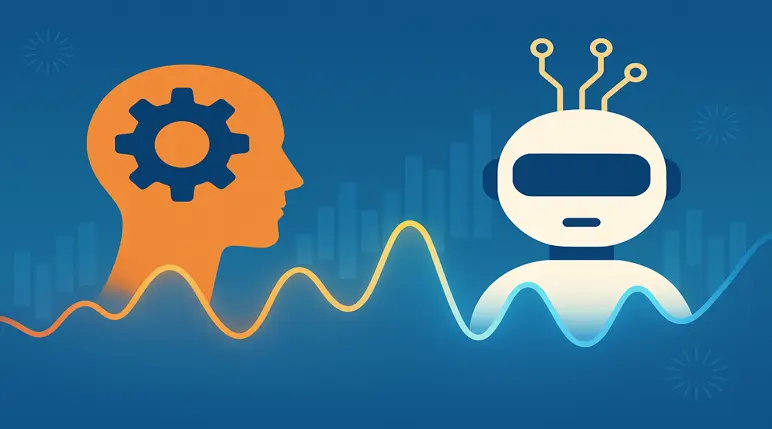
🧠 Conclusion
In this article, we explored the dynamic tension between AI trading vs human trading, peeling back the layers of what makes each approach uniquely powerful. AI trading systems excel in speed, scalability, and precision, capable of processing vast amounts of data in milliseconds without hesitation. On the other hand, human traders bring an irreplaceable sense of intuition, emotional awareness, and contextual judgment to the trading floor.
It’s not a simple matter of man vs machine. The best results often come from synergy, where the insight of human experience guides the relentless logic of algorithmic trading. As the trading world evolves, the question might not be “Who does it better?” but rather “How can they work better together?”


