
Why a Trading Journal Is More Than a History Log
Most traders treat their Trading Journal like a diary of wins and losses — a place to record what happened, when, and why it went wrong or right. But if all you’re doing is logging past trades, you’re only scratching the surface.
A true Trading Journal is not a graveyard of past mistakes or a trophy case for your biggest wins. It’s a living, breathing lab — a personal strategy incubator that holds the raw ingredients of your future breakthroughs.
Think of it this way: hindsight is only helpful if it becomes foresight. Every entry, every note, every emotion you write down is data. And that data, when mined correctly, can reveal patterns no chart or indicator will ever show you.
The magic starts when you stop asking “What happened?” and begin asking “What can I learn and build from this?”
This article isn’t about just tracking your trades — it’s about thinking outside the box and using your Trading Journal to develop new strategies that are tailor-made for your unique style, mindset, and market experience.
Ready to turn your journal into your edge? Let’s dive in.
Shift Your Perspective: Don’t Just Record, Reflect
Too many traders treat their Trading Journal like a spreadsheet — a sterile list of entries, exits, and profit/loss numbers. But trading is human. And so is journaling. If you’re only capturing price points, you’re ignoring the most potent variable in your strategy: you.
Patterns aren’t always about price. Sometimes, the real signals are in your decisions, not the charts. Did you hesitate to enter a trade you had planned for days? Did fear push you to exit early? Did overconfidence make you ignore your stop loss?
These behavioral patterns — the ones driven by emotion, mindset, and market context — often repeat more predictably than price action itself.
Start logging more than just numbers. Track your emotional state before, during, and after trades. Were you anxious, calm, distracted, or impulsive? Pair that with the market conditions: was there high volatility? Were you trading during news events or in a sideways market?
Now connect the dots. You might uncover trends like:
- You take better trades when you’ve had 8+ hours of sleep.
- You lose more often when trading right after a losing streak.
- Your setups fail more in low-volume environments, regardless of technical perfection.
These are the hidden edges most traders never find — because they’re too focused on the chart, not the human behind the chart. Your Trading Journal can expose these blind spots. But only if you reflect, not just record.

The Data Within: Mining Insights from Your Trades
Your Trading Journal is more than a notebook — it’s a data mine, and inside it lies the raw material for your next great strategy. But you have to dig with purpose.
What worked — and more importantly, why?
Don’t just celebrate your winning trades. Break them down.
Was it the setup? The market conditions? Your mindset that day?
Did your timing align with a specific session or event?
One winning trade doesn’t mean much on its own, but ten similar ones can reveal a repeatable edge.
Look for recurring setups that consistently work for you. These might be technical patterns, entry triggers, or even time-of-day preferences. Some traders unknowingly do better in the opening hour, while others thrive in choppy, midday markets.
Explore timing patterns:
- Are your trades more profitable after economic announcements?
- Do certain weekdays perform better for specific asset classes?
- Are you more disciplined in the morning vs. late in the day?
Track asset-specific behavior as well. Maybe you keep forcing trades on EUR/USD, but your best results come from gold or NASDAQ futures. A solid Trading Journal can reveal the silent heroes in your portfolio — and the consistent underperformers.
Journal your mistakes — they’re gold.
This might sound odd, but your losing trades are often more valuable than the winners.
Why? Because they show you exactly where your current strategy fails — and that’s the beginning of innovation.
Ask yourself:
- Did I follow my plan or go rogue?
- Was the setup valid, or did I force it?
- What would I do differently next time?
By journaling your thought process, not just the outcome, you create space for iteration. A failed trade becomes a case study, and over time, these case studies evolve into more innovative, sharper strategies — tailored to you.
The truth is, you don’t need to mimic a pro trader’s system. Your trade history holds the blueprint to your edge. All you have to do is look inside your Trading Journal — and start connecting the dots.

Beyond the Obvious: Asking Unusual Questions
Most traders ask the same surface-level questions when reviewing their Trading Journal:
“Was it a win or a loss?”
“Did I follow my setup?”
“How was the risk-to-reward?”
But breakthroughs rarely come from obvious questions. They come from digging deeper — from asking the unusual questions others overlook. That’s where your Trading Journal becomes a tool for discovery, not just documentation.
Did news events align with your entries?
Maybe you’re not a news trader. Still, did you unknowingly enter a position just before a high-impact event?
Or maybe your best trades tend to occur after volatility spikes from news.
Cross-referencing your trades with an economic calendar could reveal how external events silently influence your results — even if news isn’t part of your strategy (yet).
Your journal can help answer:
- Was I reacting or anticipating?
- Do I trade better before or after major headlines?
Did you exit too early on winning trades? Why?
We’ve all been there: you take profit, only to see the asset skyrocket another 200 pips.
Instead of brushing it off, ask why.
- Were you afraid to lose your gains?
- Did a minor pullback shake your confidence?
- Did you lack a clear exit strategy?
These aren’t just emotional notes — they’re blueprints for upgrading your strategy rules.
By identifying patterns in premature exits, you can create better trailing stops, re-entry tactics, or even build confidence in letting winners run.
Can your data reveal new timeframes or assets worth exploring?
Sometimes your Trading Journal quietly whispers opportunities you’ve never considered:
- Your scalps on USD/JPY fail, but swing trades on GBP/JPY shine
- You lose in 1-minute charts but perform well on 1-hour setups
- Crypto trades bring more consistency than forex during certain months
These insights won’t scream at you from a P&L column — they hide in the metadata of your behavior and results.
When you ask unusual questions, you give your journal the power to expand your horizons, not just reinforce what you already think you know.
Because sometimes, the next step in your growth isn’t better execution — it’s better questions.
Visualization = Strategy Discovery
Words and numbers are powerful, but sometimes, your brain needs pictures to connect the dots truly. That’s where visualization becomes a game-changer in your Trading Journal.
Charts, graphs, heatmaps, and tags don’t just make your journal look more organized — they unlock strategic insights that raw text often hides.
How visual tools can spark fresh ideas
Imagine seeing a heatmap that highlights all your profitable trades by time of day. Suddenly, you notice that 80% of your wins happen between 10 AM and 12 PM — something you’d never realize just reading through trade logs.
Or maybe a pie chart shows that most of your losses come from one asset class, while your best trades cluster around a specific strategy tag.
These aren’t just pretty graphics — they’re clues.
Clues that lead to new hypotheses,l ike:
- Should I limit trading to specific sessions?
- Is it time to drop or adjust certain setups?
- Am I more consistent in trending markets vs. ranging ones?
Modern Trading Journals (digital platforms or customized spreadsheets) often allow tagging, filtering, and graph generation — use them to visualize performance by setup, instrument, risk level, or emotional state.
Spotting anomalies that spark hypotheses
Sometimes the best strategy ideas don’t come from patterns — they come from outliers.
That one trade where you broke your rules but still won big.
That day, you followed every rule — and still lost.
When visualized, these anomalies stand out like red flags — or golden stars. They invite questions:
- What was different about this trade?
- Was it luck, or does it reveal an overlooked opportunity?
- Should I test this “mistake” as a potential new strategy?
By treating these anomalies as data points worth exploring — not dismissing — you move into the mindset of a strategist, not just a trader.
In the end, your Trading Journal isn’t just about documenting the past.
With the right visuals, it becomes a window into future possibilities — helping you discover strategies no one else sees, because no one else has your journal.

Testing Hypotheses Based on Past Trades
It’s one thing to spot a pattern in your Trading Journal — it’s another to test it and see if it holds up.
That’s where the magic happens: turning raw insights into paper-tested strategies.
Turning journal insights into paper-tested strategies
Your Trading Journal gives you more than numbers. It gives you context — the human side of your trades: what you were thinking, how the market felt, and what led you to act.
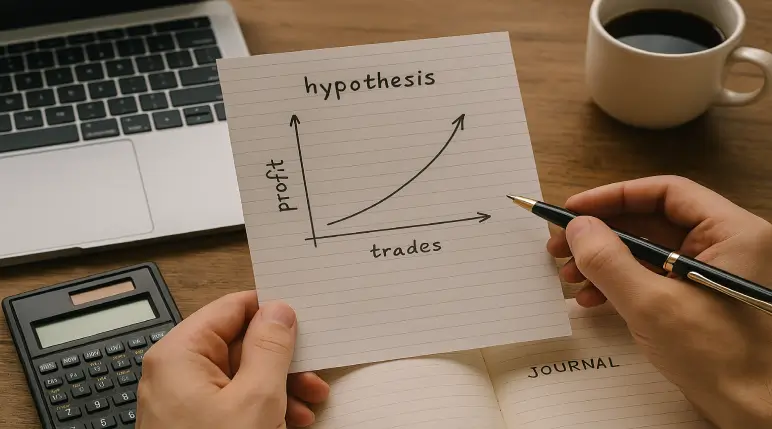
Let’s say you notice that your most successful trades happen after a specific setup during low-volatility afternoons. That’s a hypothesis. Now what?
You don’t need fancy backtesting software to validate it. Start by:
- Tagging all similar trades in your journal
- Reviewing their outcomes over time
- Identifying the risk-reward ratio, frequency, and win rate
- Asking yourself: Is this repeatable? Scalable? Emotionally manageable?
Then, start paper trading the strategy in real-time, but without money. Track results. Tweak. Refine. Repeat.
This process is not only more personal than algorithmic backtesting — it’s often more realistic, especially for discretionary traders.
Why your journal might beat backtesting software
Backtesting software runs numbers — fast and without emotion. But it can’t replicate you:
- It doesn’t understand hesitation
- It won’t factor in distractions, fatigue, or confidence
- It can’t tell when you “almost clicked” but didn’t
Your Trading Journal, on the other hand, contains the human layer — the variable most algorithms ignore. That’s your edge.
Some of your best strategies may not come from textbook-perfect setups but from real-world observations only you could make:
- A setup that works when you’re fully focused
- A pattern you trust because you’ve lived through it dozens of times
- A playbook tailored to your unique psychology, not someone else’s code
So don’t underestimate the power of analog testing in a digital world. Sometimes the best way forward is to look backward — into your journal — and test like a scientist, but with the intuition of a trader.
Building Strategy DNA: Your Journal as a Custom Framework
No two traders are the same, and that’s precisely why no single strategy works for everyone.
Your risk tolerance, schedule, mindset, and even emotional patterns are unique.
So why follow a one-size-fits-all plan when you can build a custom strategy framework using your Trading Journal?
Each trader is unique, so their strategy should be
The best strategies aren’t just profitable — they fit you.
They reflect how you think, when you perform best, and what kind of setups make you feel in control.
Your Trading Journal is where all of that personality shows up in data form.
Maybe you’re naturally patient and notice better results when trades last several hours. Or perhaps you thrive in fast-paced action and struggle when trades drag on.
Instead of forcing yourself into a predefined trading style, let your journal show you what already works for you.
Using Trading Journal tags to outline playbooks
One of the most underused features in digital Trading Journals is tagging.
Tags can help you categorize and compare trade types — setups, entry styles, asset classes, time of day, emotional state, market conditions, etc.
Over time, those tags become playbooks:
- “High-volatility breakout” trades
- “Reversal entries with RSI confirmation”
- “London session scalps on GBP pairs”
Now you’re not just reviewing isolated trades — you’re identifying repeatable patterns, building a catalog of proven approaches tailored to your experience.
Journals for swing vs. scalping — different lenses, different insights
The way you use your Trading Journal should reflect your trading style.
For scalpers, focus on:
- Time of entry/exit to the minute
- Emotional state before quick decisions
- Precision and speed-based metrics
- Market reaction to tiny shifts
For swing traders, emphasize:
- Daily and weekly context
- Longer-term patterns and news influences
- Risk-to-reward consistency
- Trade management and patience tracking
Each lens produces different insights. But both are powerful, as long as you’re journaling with intention.

Conclusion
In this article, we explored how your Trading Journal can become much more than a record of wins and losses — it can evolve into a powerful engine for personal growth and strategic discovery.
We shifted the lens from passive tracking to active reflection, showing how to uncover emotional patterns, behavioral trends, and asset-specific insights that often go unnoticed. By asking better questions, visualizing your data, and turning insights into testable hypotheses, you begin transforming your journal into a laboratory — one that’s uniquely yours.
We also looked at the importance of customizing your strategy based on your trading DNA — not someone else’s system — and how tags, journaling styles, and trade categorization can give you profound clarity, whether you’re a scalper, swing trader, or somewhere in between.
Your Trading Journal is not just a tool — it’s a mirror, a microscope, and a map. Use it wisely, and it won’t just tell you where you’ve been — it will guide you to where you’re meant to go.
Keep writing. Keep evolving. And remember: your next great strategy is already hidden in your past trades — you just need to read between the lines.


