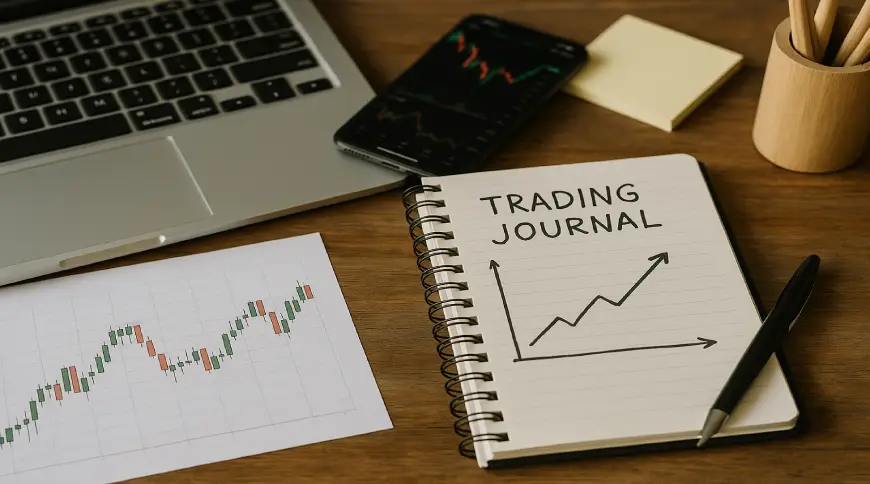
In a world where AI bots can analyze charts in milliseconds and social sentiment tools scream “Buy” or “Sell” every five minutes, the idea of sitting down to write in a journal might sound outdated. But here’s the truth: journaling isn’t slow—it’s smart.
While most traders chase the next signal, trying to outpace algorithms, seasoned performers know that the real edge isn’t just in faster execution—it’s in more profound understanding. That’s where journaling comes in. It’s not about logging trades just for the sake of record-keeping. It’s about slowing down to see what others miss.
Because let’s be honest: data without context is noise. And decisions made without self-awareness? Often expensive. A trading journal, used creatively, can transform scattered trades into a strategy, surface emotional blind spots, and turn lessons into patterns you can use.
This article isn’t about bullet points and templates. It’s about Improving Your Trading Performance with Journaling by tapping into your thought process, emotional cues, and personal style. It’s journaling not as a chore, but as a creative weapon.
Emotion Mapping: Capture the Unseen Forces
Ever placed a trade with confidence, only to exit too early because of a sudden gut feeling? Or held onto a losing position longer than you should, hoping it might turn around? These aren’t strategy flaws—they’re emotional ones. And most traders never stop to map them.
Emotion mapping is the practice of tracking how you feel during critical moments of a trade—such as entry, exit, drawdown, or breakout. Fear, greed, hesitation, overconfidence—these aren’t just mood swings; they’re performance triggers that silently shape your results.
By journaling your emotional state alongside each trade, patterns begin to surface. You may always hesitate after three consecutive losses. Big wins lead to impulsive re-entries. These insights are gold—because once you recognize the psychological loops behind your behavior, you can begin to break them.
The goal isn’t to remove emotion (you’re human, not a bot), but to translate emotions into actionable data. That’s what turns emotional trading into strategic self-awareness. And that’s how you start making decisions not from reaction, but from reflection.
Pro tip: Add a 1–10 rating scale in your journal for confidence level, stress, or clarity at the moment of trade. Over time, those numbers will speak louder than your profit and loss statement.
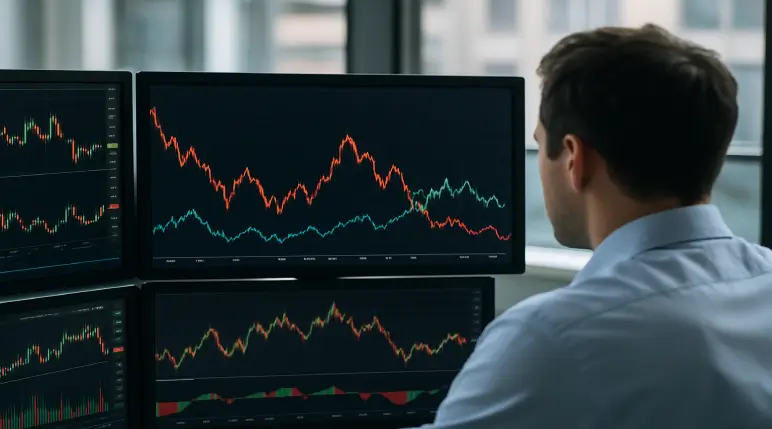
Visual Journaling: Let Charts Talk to You
Not every trader thinks in words. Some of us view the market as a rhythm—patterns, shapes, and momentum. If that’s you, it’s time to ditch the long paragraphs and let your journal speak your language: visuals.
Visual journaling isn’t about pretty aesthetics—it’s about clarity through structure. Annotate your entry and exit points directly on screenshots. Sketch failed setups. Highlight where your stop loss got triggered or where the price reacted to support but didn’t hold. Sometimes, one marked-up chart reveals more than a thousand words.
When you look back through your visual trade journal, recurring patterns will jump off the page—ones you might’ve missed in text-only entries. You’ll spot that specific breakout you always misjudge, or realize you’re more accurate trading specific structures over others. This is pattern recognition at its most intuitive.
And you don’t need expensive software. Try tools like Notion for clean image grids and notes, Obsidian for markdown-based visual tracking, or GoodNotes if you like to draw trades by hand on a tablet. The right tool is whatever helps you see your thought process more clearly.
Because when your journal becomes a visual map of your journey—not just a written log—it transforms from a record into a strategy discovery engine.

Storytelling Your Trades: From Logs to Lessons
Every trade has a story. But most journals treat trades like cold data—entry here, exit there, profit X. That’s fine for bookkeeping, but if you want growth, you need something richer. You need a narrative.
Storytelling your trades means writing them like mini case studies. What was your setup? What were you thinking? What did you expect—and what happened? Did you follow your rules or break them? Was luck involved? Fear? FOMO? The goal isn’t to impress; it’s to uncover the truth behind the trade.
When you capture trades this way, something powerful happens: you remember them. You learn from them. The win isn’t just a number—it becomes a lesson. The loss isn’t just red ink—it becomes a warning sign. This is the core of case-based learning: anchoring ideas to authentic experiences, so they remain firmly in place.
Ask yourself: What’s the moral of this trade? Was it patience? Discipline? Don’t trade during meetings? Whatever it is, could you write it down? These reflections add up over time and shape your internal playbook—your instinct.
And that’s what reflective journaling is all about. You’re not just tracking what you did. You’re extracting who you are as a trader—and who you want to become.

Hypothesis Writing: Become Your Strategist
Great traders don’t just react—they predict, test, and refine. Instead of unthinkingly chasing setups, they start with a plan, a theory, a “what if.” That’s where hypothesis writing comes in—and it’s a game-changer.
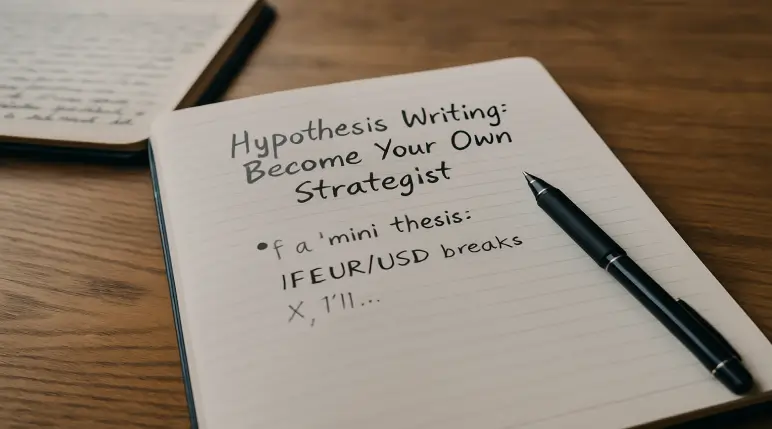
Each week (or each trading day), write a mini-thesis in your journal. Something intentional but straightforward, like:
“If EUR/USD breaks above 1.0950 with volume, I’ll look for a retest and long entry.”
Now, the magic: test it. Don’t just wait and see—actively track whether your idea came to fruition. What happened? Did the price behave as expected? Did you act according to your plan? Or did emotion hijack the trade?
These micro-experiments are what turn journals into strategy refinement tools. Over time, you’ll begin to see which types of hypotheses work best for your style. You’re not just recording the past—you’re coaching your future self.
This approach turns your journal into a feedback engine. It helps you separate luck from logic, emotion from execution. You move from “Why did I take that trade?” to “How did my theory hold up?”
It’s deliberate practice, done right.
So forget random journaling. Start journaling experiments. Start thinking like a strategist, not just a trader.
Ritualize Review: Make Weekly Audits Non-Negotiable
Most traders have journals. Fewer use them. And even fewer go back and review them with intention.
Logging trades is step one—but the real value comes when you sit down and ask: “What is this telling me?” That’s where the practice of a weekly trading audit comes in. It’s not glamorous, but it’s where growth hides.
Block off 30–60 minutes at the end of each week. No charts. No noise. Just you and your journal. Ask the tough questions:
- What setups worked consistently?
- Where did I hesitate or overtrade?
- What emotional patterns are repeated?
- What hypothesis was validated—or disproven?
Build a simple scorecard or dashboard to track performance metrics over time: win rate, average risk/reward, emotional confidence score, and setup type success rate. These aren’t just numbers—they’re signals for decision-making and performance improvement.
This is where self-analysis becomes a superpower. You’ll start noticing micro-adjustments that compound: one less revenge trade, one better entry, one tighter stop. That’s how performance shifts from average to intentional.
So set a date with your journal—every week, without exception. Because consistency in review leads to consistency in results.

Conclusion
In this article, we explored how journaling—when used creatively—can become a powerful tool for improving your trading performance. Not just a record-keeping habit, but a strategic weapon.
From emotion mapping to uncover hidden behavioral patterns, to visual journaling for intuitive insights, we saw how different approaches bring your trades to life. Through storytelling, your past becomes a library of lessons. With hypothesis writing, you shift from reaction to intention. By ritualizing weekly reviews, you transition from chaos to clarity.
In a world of automation and noise, your edge may not be faster execution, but more profound reflection.
Because ultimately, your trading journal isn’t just about your trades. It’s about you. Your mindset. Your discipline. Your growth.
Write it well. Revisit it often. And let it guide the trader you’re becoming.


