
The financial markets have always been a battlefield of speed, precision, and psychology. Traders—whether day traders chasing intraday moves or swing traders analyzing longer trends—constantly face one stubborn challenge: information overload. The charts are noisy, trends shift faster than ever, and opportunities often slip away before traders can react to them.
This is where Artificial Intelligence (AI) steps in as more than just a buzzword. Instead of relying solely on traditional technical indicators that often lag, modern trading now leverages AI-powered advanced pattern recognition. Unlike the human eye, which struggles to process massive data streams in real time, AI can scan, detect, and interpret complex patterns hidden deep within the market’s chaos.
For traders aged 20 to 40, who balance ambition with the need for more intelligent decision-making, this technology isn’t just a futuristic concept—it’s a practical solution. By filtering noise, identifying subtle shifts, and unlocking new opportunities, AI-powered advanced pattern recognition is reshaping the way we approach trading strategies today.
What is AI-powered Advanced Pattern Recognition?
At its core, AI-powered advanced pattern recognition is the ability of Artificial Intelligence to scan massive amounts of financial data and detect recurring behaviors or hidden relationships that traditional tools often miss. For traders, this means going beyond simple chart analysis—AI can uncover subtle signals that would otherwise be invisible to the human eye.
Unlike conventional technical analysis, which relies on static indicators like moving averages or RSI, AI-powered advanced pattern recognition adapts and learns continuously. Instead of applying one fixed formula to every market condition, AI systems evolve with new data, identifying fresh opportunities even in highly volatile or unfamiliar environments.
The real engine behind this lies in Machine Learning, Deep Learning, and Neural Networks. These models are designed to “train” on historical price movements, news sentiment, and even cross-asset correlations. Over time, they become better at recognizing patterns such as early trend reversals, abnormal price spikes, or correlations between assets that humans would never connect.
In simpler terms, think of it as having a trading assistant who never sleeps, analyzes millions of scenarios in real-time, and highlights only the most meaningful opportunities—without being distracted by noise.
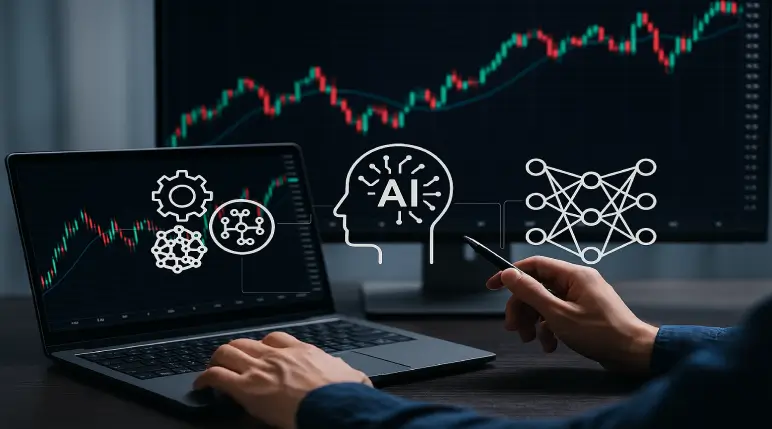
How It Unlocks New Trading Opportunities
The real power of AI-powered advanced pattern recognition lies in its ability to see what human traders often miss. Markets are filled with complex interactions—tiny shifts in volume, hidden correlations between assets, or price behaviors that don’t fit traditional textbook patterns. While most traders rely on well-known setups, such as head-and-shoulders patterns or moving average crossovers, AI goes deeper, uncovering sophisticated signals that remain invisible to the naked eye.
Another key advantage is real-time detection. Traditional methods of analysis often lag; by the time a signal becomes obvious, the market has already moved. In contrast, AI systems process vast streams of data instantly, enabling traders to spot opportunities as they emerge, rather than hours or days later. This speed can make the difference between catching a breakout early and chasing it too late.
Ultimately, AI significantly enhances accuracy by minimizing false signals. Every trader knows the frustration of entering a trade based on a “perfect setup” that quickly fails. By filtering out market noise and validating patterns with multiple layers of data, AI-powered advanced pattern recognition enables traders to focus solely on high-probability opportunities. This not only enhances potential returns but also strengthens risk management, allowing the traders to preserve capital while taking more informed risks.
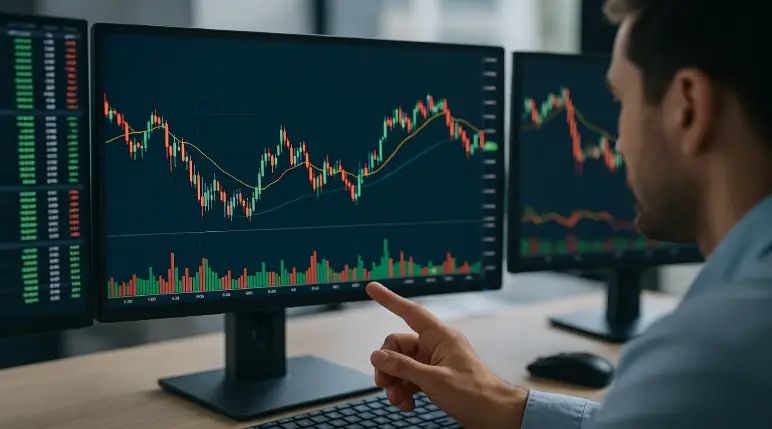
Practical Use Cases for Traders
While the theory behind AI-powered advanced pattern recognition may sound impressive, its actual value becomes evident in real-world trading scenarios. Here are some of the most potent applications that directly impact traders’ daily decisions:
1. Trend Reversals
One of the most challenging tasks for traders is identifying when a strong trend is about to reverse. Traditional tools usually confirm a reversal only after it has already happened. AI, however, can detect subtle shifts in momentum, order flow, and volume dynamics long before human traders see the signs. By identifying these early signals, traders can position themselves ahead of the market instead of reacting too late.
2. Hidden Correlations
Markets are more connected than most realize. For instance, a slight shift in commodities might subtly impact tech stocks, or currency fluctuations could signal impending equity volatility. AI-powered advanced pattern recognition excels at uncovering these hidden correlations across assets, enabling traders to anticipate moves in one market based on signals from another. This holistic perspective opens doors to more intelligent diversification and cross-market strategies.
3. Anomaly Detection
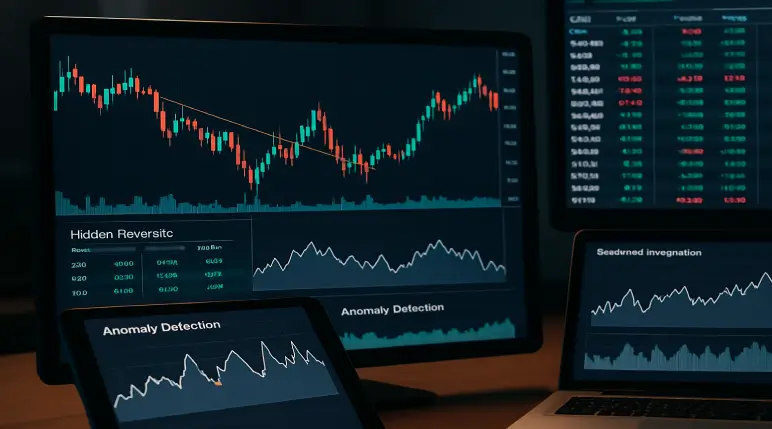
Markets don’t always behave predictably—sometimes they break their own rules. AI can flag anomalies, such as unusual spikes in volume, liquidity gaps, or sudden price moves that precede significant volatility. Detecting these irregularities in advance gives traders the edge to either capitalize on them or protect themselves from potential risks.
4. Sentiment Integration
Numbers tell one side of the story, but market sentiment drives the other. By integrating social media chatter, news headlines, and alternative data into its models, AI can combine emotional and technical insights into a comprehensive view. This allows traders to understand not only what the charts are saying but also how the crowd is feeling—an essential edge in today’s fast-moving markets.
In short, these use cases show how AI-powered advanced pattern recognition doesn’t just improve trading efficiency—it transforms the way traders interpret markets, blending technical precision with psychological awareness.
Challenges and Red Flags
While AI-powered advanced pattern recognition offers incredible opportunities, it isn’t without risks. Traders who adopt these tools must remain vigilant to potential pitfalls, thereby avoiding costly mistakes.
1. The Risk of Overfitting
One of the biggest challenges in AI trading models is overfitting—when an algorithm becomes too specialized in past data and fails to adapt to new market conditions. A system that performs brilliantly in backtests may collapse in live trading because it learned to “memorize” history rather than recognize genuine, repeatable patterns. Traders must ensure their AI tools are tested across different regimes, timeframes, and assets to confirm true adaptability.
2. Buzzword “AI” in Low-Quality Tools
The financial industry is flooded with platforms that slap the “AI” label on their products without real substance. Many of these so-called AI solutions rely on static formulas or basic automation disguised as intelligence. For traders, this creates the risk of relying on tools that fail to deliver the promised edge. A critical red flag is when a platform heavily markets itself around “AI” but fails to explain the mechanics behind its pattern recognition.
3. The Need for Quality Data
AI is only as good as the data it learns from. Poor, limited, or biased data leads to inaccurate signals and unreliable predictions. For AI-powered advanced pattern recognition to work effectively, it requires high-quality, diverse, and up-to-date datasets. This means integrating not only historical price movements but also real-time feeds, alternative data sources, and sentiment analysis. Without this foundation, even the most advanced algorithms can deliver misleading results.
In short, while AI can open doors to smarter and faster trading, traders must remain cautious. Awareness of these challenges helps ensure that AI becomes a reliable partner—not a hidden liability.

The Future of Trading with AI
The evolution of AI-powered advanced pattern recognition is only the beginning. As technology advances, the future of trading is poised to become even more dynamic, efficient, and intelligent.
1. Moving Toward Autonomous Trading Systems
We are gradually shifting from human-led trading supported by algorithms to autonomous trading systems that can independently scan markets, manage risk, and execute trades in real time. These systems won’t just react to signals—they will continuously adapt, learning from both successes and failures to refine strategies on the fly. For traders, this could mean access to an “always-on” partner capable of operating at a scale and speed that humans alone cannot achieve.
2. Synergy Between Human Intuition and AI Insights
Despite the rise of automation, human intuition remains invaluable. The future isn’t about replacing traders, but about creating a synergy between human intuition and AI-powered insights. While AI can process millions of data points and detect hidden patterns, human traders provide the contextual judgment, emotional intelligence, and creativity that machines lack. Together, this partnership forms a powerful hybrid model that combines precision with perspective.
3. AI as the New Market Standard
In the coming years, AI-powered advanced pattern recognition will transition from a competitive advantage to a new standard across global markets. Just as technical indicators once transformed trading decades ago, AI-driven tools will become a baseline expectation for traders. Those who fail to adapt risk falling behind, while those who embrace the shift will discover new opportunities that redefine the rules of the trading game.
The future of trading is not just faster or more data-driven—it’s smarter. At the core of that intelligence lies the seamless integration of AI-powered, advanced pattern recognition into everyday decision-making.
Conclusion
In this article, we explored how AI-powered advanced pattern recognition is transforming the trading landscape by unlocking opportunities that traditional tools often miss. From detecting trend reversals and hidden correlations to reducing false signals and integrating sentiment data, AI is proving to be more than just a technological upgrade—it’s becoming a strategic partner for traders.
While challenges such as overfitting, poor data quality, and misleading “AI” labels exist, the potential of this technology far outweighs the risks when approached with awareness and caution. The synergy between human intuition and machine intelligence paves the way for smarter, faster, and more resilient trading strategies.
Looking ahead, AI-powered advanced pattern recognition is poised to become the new standard in financial markets. For traders in their 20s, 30s, and beyond, embracing these tools today means not only staying competitive but also gaining a head start in the future of autonomous, intelligent trading.


